
Sign in to see your personalized home page
Great Deals on Used Textbooks & New Textbooks!             
My Account | Help Desk | Market Place Shopping Cart
Free shipping. Click here for details.
No items in cart.
Total: $0.00
Textbooks Sell Textbooks Books Supplies Medical Books College Apparel Movies Clearance
Search  Advanced >>
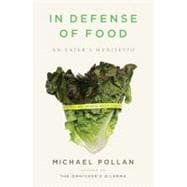
Cover Art for In Defense of Food: An Eater's Manifesto
Other versions by this Author
We Buy This Book Back!

In Defense of Food: An Eater's Manifesto


Edition: 1st
Author(s): Pollan, Michael
ISBN10:  1594201455
ISBN13:  9781594201455
Format:  Hardcover
Pub. Date:  1/1/2008
Publisher(s): Penguin Group USA
Adopted Book

Buy in Bulk
Send to a friend
New Price  $15.14
List Price $21.95
eVIP Price  $14.39
New Copy:  In Stock Usually Ships in 24 Hours
add remove
Used Price  $16.46
List Price $21.95
eVIP Price  $15.64
Used Copy: In Stock Usually Ships in 24 Hours.
3 used available 3 used available
Marketplace Price $12.51
List Price $21.95 Available in the eCampus Marketplace
eBook Price $14.39
What is an eBook?
Add eBook to Cart
Electronic Copy: Will be Delivered Electronically
Take 90 Days to Pay on $250 or more
with Quick, Easy, Secure
Subject to credit approval.
SummaryAuthor BiographyEditorial Reviews
What to eat, what not to eat, and how to think about health: a manifesto for our times

"Eat food. Not too much. Mostly plants." These simple words go to the heart of Michael Pollan's In Defense of Food, the well-considered answers he provides to the questions posed in the bestselling The Omnivore's Dilemma.

Humans used to know how to eat well, Pollan argues. But the balanced dietary lessons that were once passed down through generations have been confused, complicated, and distorted by food industry marketers, nutritional scientists, and journalists-all of whom have much to gain from our dietary confusion. As a result, we face today a complex culinary landscape dense with bad advice and foods that are not "real." These "edible foodlike substances" are often packaged with labels bearing health claims that are typically false or misleading. Indeed, real food is fast disappearing from the marketplace, to be replaced by "nutrients," and plain old eating by an obsession with nutrition that is, paradoxically, ruining our health, not to mention our meals. Michael Pollan's sensible and decidedly counterintuitive advice is: "Don't eat anything that your great-great grandmother would not recognize as food."

Writing In Defense of Food, and affirming the joy of eating, Pollan suggests that if we would pay more for better, well-grown food, but buy less of it, we'll benefit ourselves, our communities, and the environment at large. Taking a clear-eyed look at what science does and does not know about the links between diet and health, he proposes a new way to think about the question of what to eat that is informed by ecology and tradition rather than by the prevailing nutrient-by-nutrient approach.

In Defense of Food reminds us that, despite the daunting dietary landscape Americans confront in the modern supermarket, the solutions to the current omnivore's dilemma can be found all around us.

In looking toward traditional diets the world over, as well as the foods our families-and regions-historically enjoyed, we can recover a more balanced, reasonable, and pleasurable approach to food. Michael Pollan's bracing and eloquent manifesto shows us how we might start making thoughtful food choices that will enrich our lives and enlarge our sense of what it means to be healthy.
Michael Pollan is the author of four previous books, including The Omnivore's Dilemma and The Botany of Desire, both New York Times bestsellers. A longtime contributor to The New York Times, he is also the Knight Professor of journalism at Berkeley.
Our obsession with nutrition is ruining our health, argues Pollan-and it makes for some really bad meals. Copyright 2007 Reed Business Information.

In his hugely influential treatise The Omnivore's Dilemma , Pollan traced a direct line between the industrialization of our food supply and the degradation of the environment. His new book takes up where the previous work left off. Examining the question of what to eat from the perspective of health, this powerfully argued, thoroughly researched and elegant manifesto cuts straight to the chase with a maxim that is deceptively simple: "Eat food, not too much, mostly plants." But as Pollan explains, "food" in a country that is driven by "a thirty-two billion-dollar marketing machine" is both a loaded term and, in its purest sense, a holy grail. The first section of his three-part essay refutes the authority of the diet bullies, pointing up the confluence of interests among manufacturers of processed foods, marketers and nutritional scientists—a cabal whose nutritional advice has given rise to "a notably unhealthy preoccupation with nutrition and diet and the idea of eating healthily." The second portion vivisects the Western diet, questioning, among other sacred cows, the idea that dietary fat leads to chronic illness. A writer of great subtlety, Pollan doesn't preach to the choir; in fact, rarely does he preach at all, preferring to lets the facts speak for themselves. (Jan.)

[Page 41]. Copyright 2007 Reed Business Information.

Check Out These Items!
eCampus.com Pink Backpack eCampus.com Pink Backpack
Retail Price $28.95
Our Price $10.00
eCampus.com T-Shirt eCampus.com T-Shirt
Retail Price $14.99
Our Price $2.00
eCampus.com 2GB USB Drive eCampus.com 2GB USB Drive
Retail Price $27.95
Our Price $22.00
  Buy Textbooks
  Sell Textbooks
  College Apparel
  Shop by School
  Virtual Bookstores
  Order Status
  Shipping Rates
  Return Policy
  Marketplace Info
  F.A.S.T.
  Contact Us
  Privacy Policy
  Legal Notices
  Site Security
  Employment
  Help Desk
  eCampus Blog
  Affiliate Program
  Bulk Orders
  College Marketing
HACKER SAFE certified sites prevent over 99.9% of hacker crime.
RSS Need Help? eService@ecampus.com   Copyright© 1999-2008     
.