
More New and Used
from Private Sellers
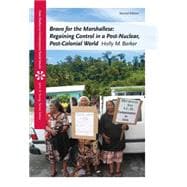
Bravo for the Marshallese : Regaining Control in a Post-Nuclear, Post-Colonial World
by Barker, Holly M.Edition:
2nd
ISBN13:
9781111833848
ISBN10:
1111833842
Format:
Paperback
Pub. Date:
3/9/2012
Publisher(s):
Cengage Learning
List Price: $63.67
Rent Textbook
(Recommended)Term
Due
Price
Short Term
Aug 2
$15.58
Semester
Sep 27
$25.47
Quarter
Aug 18
$22.28
$15.58
Buy Used Textbook
In Stock Usually Ships in 24 Hours.
$44.57
Buy New Textbook
Currently Available, Usually Ships in 24-48 Hours
$62.08
eTextbook
180 day subscription
$37.19
Questions About This Book?
Why should I rent this book?
Renting is easy, fast, and cheap! Renting from eCampus.com can save you hundreds of dollars compared to the cost of new or used books each semester. At the end of the semester, simply ship the book back to us with a free UPS shipping label! No need to worry about selling it back.
How do rental returns work?
Returning books is as easy as possible. As your rental due date approaches, we will email you several courtesy reminders. When you are ready to return, you can print a free UPS shipping label from our website at any time. Then, just return the book to your UPS driver or any staffed UPS location. You can even use the same box we shipped it in!
What version or edition is this?
This is the 2nd edition with a publication date of 3/9/2012.
What is included with this book?
- The New copy of this book will include any supplemental materials advertised. Please check the title of the book to determine if it should include any CDs, lab manuals, study guides, etc.
- The Used copy of this book is not guaranteed to inclue any supplemental materials. Typically, only the book itself is included.
- The Rental copy of this book is not guaranteed to include any supplemental materials. You may receive a brand new copy, but typically, only the book itself.
Related Products
Summary
This case study describes the role an applied anthropologist takes to help Marshallese communities understand the impact of radiation exposure on the environment and themselves, and addresses problems stemming from the U.S. nuclear weapons testing program conducted in the Marshall Islands from 1946-1958. The author demonstrates how the U.S. Government limits its responsibilities for dealing with the problems it created in the Marshall Islands. Through archival, life history, and ethnographic research, the author constructs a compelling history of the testing program from a Marshallese perspective. For more than five decades, the Marshallese have experienced the effects of the weapons testing program on their health and their environment. This book amplifies the voice of the Marshallese who share their knowledge about illnesses, premature deaths, and exile from their homelands. The author uses linguistic analysis to show how the Marshallese developed a unique radiation language to discuss problems related to their radiation exposure ? problems that never existed before the testing program. Drawing on her own experiences working with the Government of the Marshall Islands, the author emphasizes the role of an applied anthropologist in influencing policy, and empowering community leaders to seek meaningful remedies.
Table of Contents
| Foreword | p. ix |
| Preface | p. xi |
| Introduction | p. 1 |
| Setting the Stage: The Geography, Social/Political Organization, and Language of the Marshall Islands | p. 5 |
| Location and Ecology | p. 5 |
| Early Migration | p. 10 |
| The Social and Political Structure | p. 10 |
| The Marshallese Language and Its Dialects | p. 12 |
| A Colonial History of the Marshall Islands | p. 16 |
| Colonial Expansion | p. 16 |
| U.S. Naval Administration of the Marshall Islands | p. 19 |
| The Arrival of Anthropologists | p. 25 |
| The Move toward Self-Governance | p. 29 |
| The Compact of Free Association | p. 30 |
| The U.S. Nuclear Weapons Testing Program | p. 34 |
| The Official U.S. Government Account of the Events | p. 34 |
| The Limitations on U.S. Government Responsibility | p. 36 |
| Declassified U.S. Government Documents | p. 39 |
| Conclusion | p. 49 |
| Ethnography and a Marshallese Narrative of History | p. 50 |
| Witness Testimonies: March 1, 1954-The Day the U.S. Government Detonated the Bravo Shot | p. 51 |
| Witness Testimonies: Evacuation and the Decontamination Process | p. 53 |
| Witness Testimonies: Birth Defects | p. 54 |
| Witness Testimonies: Other Medical and Environmental Problems | p. 55 |
| Witness Testimonies: Interactions with U.S. Government Medical Providers and Scientists | p. 56 |
| A Marshallese Narrative of History | p. 57 |
| Conclusion | p. 59 |
| Alienation from the Land: The Rongelap Experience | p. 60 |
| The Importance of Geography | p. 60 |
| The Importance of Land | p. 61 |
| Damage, Injury, and Loss | p. 63 |
| Experiences in Exile | p. 64 |
| The Loss of Self-Sufficiency | p. 66 |
| Burial | p. 69 |
| Stigma/Psychological Problems among the "Bombed People" | p. 71 |
| Gender, Age, and Status in Exile | p. 72 |
| Conclusion | p. 75 |
| Language and the Testing Program | p. 76 |
| Radiation and a Colonial Language of Control | p. 76 |
| Language as Resistance | p. 79 |
| Conclusion | p. 92 |
| Uncovering Themes in Linguistic Data | p. 93 |
| Assigning Responsibility | p. 94 |
| Powerlessness | p. 98 |
| Women's Reproductive Illnesses | p. 101 |
| A Unique Marshallese Radiation Language | p. 107 |
| Conclusion | p. 110 |
| Changed Circumstances: Petitioning the U.S. Government | p. 111 |
| Advisory Committee on Changed Circumstances | p. 113 |
| Content of the Petition | p. 113 |
| Review of the Petition | p. 115 |
| Conclusion | p. 116 |
| Other Case Studies | p. 117 |
| Hiroshima/Nagasaki | p. 117 |
| French Polynesia | p. 120 |
| Chernobyl | p. 123 |
| Nevada | p. 126 |
| Hanford | p. 128 |
| Subjects of Human Radiation Experimentation | p. 133 |
| Conclusion | p. 135 |
| Methods and Community Empowerment | p. 136 |
| Developing Bonds of Trust | p. 136 |
| Learning the Language | p. 136 |
| Archival Research | p. 137 |
| Access to Information | p. 137 |
| Building on the Work of Others | p. 137 |
| Life Story and Oral History Collection | p. 138 |
| Local Counterparts and Key Informants | p. 139 |
| Public Education and Training of Students | p. 139 |
| Transcription and Translation | p. 141 |
| Observation | p. 142 |
| Expect to Be Challenged | p. 143 |
| Fieldnotes | p. 144 |
| Repeat Visits to the Field | p. 144 |
| The Policy Realm | p. 144 |
| Methods of the NCT Project | p. 145 |
| Conclusion | p. 148 |
| Competing Narratives of History | p. 149 |
| Flaws in the U.S. Government's Accounting of History | p. 150 |
| A New Narrative of History | p. 152 |
| Looking toward the Future | p. 153 |
| The Failure of Reconciliation and the Mobility of Structural Violence | p. 155 |
| Rongelap Ultimatum | p. 156 |
| Structural Violence | p. 157 |
| Mounting Tension | p. 158 |
| Mixed Messages | p. 161 |
| Applied and Public Anthropology | p. 163 |
| Budgetary Cuts Threaten Lives of Washington's Hungry and Sick | p. 163 |
| Nuclear Claims Tribunal | p. 165 |
| Anthropology and the Rongelap Land Claim | p. 166 |
| Climate Change and Sea-Level Rise | p. 168 |
| Conclusion | p. 172 |
| Bibliography | p. 175 |
| Appendix Categories for Personal Injury Awards, Nuclear Claims Tribunal | p. 182 |
| Glossary | p. 184 |
| Index | p. 185 |
| Table of Contents provided by Ingram. All Rights Reserved. |
CART


