
More New and Used
from Private Sellers
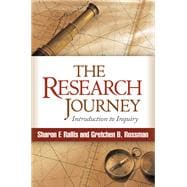
The Research Journey; Introduction to Inquiry
by Sharon F. Rallis, EdD, School of Education, University of Massachusetts at AmherEdition:
1st
ISBN13:
9781462505128
ISBN10:
1462505120
Format:
Trade Paper
Pub. Date:
3/29/2012
Publisher(s):
The Guilford Press
List Price: $36.00
Rent Textbook
(Recommended)Term
Due
Price
Short Term
Aug 2
$18.00
Semester
Sep 28
$21.60
Quarter
Aug 19
$19.80
$18.00
Buy New Textbook
Usually Ships in 2-4 Business Days
$35.10
eTextbook
$35.47
Used Textbook
We're Sorry
Sold Out
Questions About This Book?
Why should I rent this book?
Renting is easy, fast, and cheap! Renting from eCampus.com can save you hundreds of dollars compared to the cost of new or used books each semester. At the end of the semester, simply ship the book back to us with a free UPS shipping label! No need to worry about selling it back.
How do rental returns work?
Returning books is as easy as possible. As your rental due date approaches, we will email you several courtesy reminders. When you are ready to return, you can print a free UPS shipping label from our website at any time. Then, just return the book to your UPS driver or any staffed UPS location. You can even use the same box we shipped it in!
What version or edition is this?
This is the 1st edition with a publication date of 3/29/2012.
What is included with this book?
- The New copy of this book will include any supplemental materials advertised. Please check the title of the book to determine if it should include any CDs, lab manuals, study guides, etc.
- The Rental copy of this book is not guaranteed to include any supplemental materials. You may receive a brand new copy, but typically, only the book itself.
Summary
Designed to foster "inquiry-mindedness," this book prepares graduate students to develop a conceptual framework and conduct inquiry projects that are linked to ongoing conversations in a field. The authors examine different ways of knowing and show how to identify a research question; build arguments and support them with evidence; make informed design decisions; engage in reflective, ethical practices; and produce a written proposal or report. Each chapter opens with a set of critical questions, followed by a dialogue among five fictional graduate students exploring questions and concerns about their own inquiry projects; these issues are revisited throughout the chapter. Other useful features include end-of-chapter learning activities for individual or group use. useful pedagogical features include: framing questions for exploration and reflection chapter-opening dialogues that bring in perspectives from multiple disciplines example boxes with detailed cases and questions for the reader end-of-chapter activities and experiential exercises that guide readers to develop their own inquiry projects suggestions for further reading.
Author Biography
Sharon F. Rallis, EdD, is the Dwight W. Allen Distinguished Professor of Education Policy and Reform at the University of Massachusetts at Amherst, where she is also Director of the Center for Education Policy. Past president of the American Evaluation Association, she has coauthored 10 books, including several on leadership.
Gretchen B. Rossman, PhD, is Chair of the Department of Educational Policy, Research, and Administration at the University of Massachusetts at Amherst. She has coauthored nine books, including the major qualitative research texts Learning in the Field (with Sharon F. Rallis) and Designing Qualitative Research (with Catherine Marshall).
Table of Contents
1. Inquiry as Learning: Beginning the Journey
Introduction
What Is Inquiry?
The Learner as Knowledge Generator
Drawing on Values and Passion
Your Journey into Systematic Inquiry
For Further Reading
2. Ways of Knowing: Finding a Compass
Ways of Knowing
Fundamental Assumptions
Mapping Perspectives
Back to Ontology and Epistemology
For Further Reading
3. The Cycle of Inquiry: More Than One Way to Get There
Inquiry in Action/Inquiry as Practice
The Systematic Inquiry Cycle
Validity, Credibility, and Trustworthiness
For Further Reading
4. Being an Ethical Inquirer: Staying Alert on the Road
Ethics in Inquiry
The Inquirer as a Moral Practitioner
Standards for Practice and Procedural Matters
Ethics, Trustworthiness, and Rigor
Ethical Theories
Ethics and Reflexivity
For Further Reading
5. Constructing Conceptual Frameworks: Building the Route
What Is a Conceptual Framework?
Building an Argument
Entering the Conversation: Your Community of Practice
Entering the Conversation: Your Engagement
Entering the Conversation: The Communities of Discourse
Ways of Organizing
Chapter Summary
For Further Reading
6. Designing the Inquiry Project: Finding “True North”
Moving from the Conceptual Framework into Design
Considering Various Designs
Samira’s Research Questions and Possible Designs
A Short Course on Research Methods
Planning for Analysis and Interpretation
The Research Proposal: Bringing it All Together
An Example of Connecting the What and the How
Chapter Summary
For Further Reading
7. Things to Consider in Writing: Staying in the Right Lane
Writing Introductions
The Nasty Problem of Plagiarism
Using Proper Citation Format
For Further Reading
8. Knowledge Use: Arriving at Your Destination
Using What You have Learned
Who Cares?: Potential Audiences
Communicating for Use
Passions and Closing the Loop
style="LINE-HEIGHT: 99%; FONT-SIZE: 10pt"For Further Reading
CART


