
More New and Used
from Private Sellers
List Price: $36.95
Rent Textbook
(Recommended)Term
Due
Price
Short Term
Aug 2
$14.78
Semester
Oct 1
$18.48
Quarter
Aug 22
$16.63
$14.78
Buy Used Textbook
Usually Ships in 3-5 Business Days
$25.31
Buy New Textbook
Usually Ships in 3-5 Business Days
$36.03
eTextbook
We're Sorry
Not Available
Questions About This Book?
Why should I rent this book?
Renting is easy, fast, and cheap! Renting from eCampus.com can save you hundreds of dollars compared to the cost of new or used books each semester. At the end of the semester, simply ship the book back to us with a free UPS shipping label! No need to worry about selling it back.
How do rental returns work?
Returning books is as easy as possible. As your rental due date approaches, we will email you several courtesy reminders. When you are ready to return, you can print a free UPS shipping label from our website at any time. Then, just return the book to your UPS driver or any staffed UPS location. You can even use the same box we shipped it in!
What version or edition is this?
This is the 3rd edition with a publication date of 3/2/2009.
What is included with this book?
- The New copy of this book will include any supplemental materials advertised. Please check the title of the book to determine if it should include any CDs, lab manuals, study guides, etc.
- The Used copy of this book is not guaranteed to inclue any supplemental materials. Typically, only the book itself is included.
- The Rental copy of this book is not guaranteed to include any supplemental materials. You may receive a brand new copy, but typically, only the book itself.
Summary
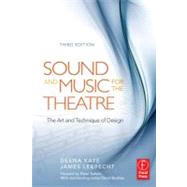
For every phase of theatrical production, Sound and Music for the Theatre traces the entire process of sound design from initial concept through closing night. The book discusses the early evolution of a sound design that supports the play, from researching sources for music and effects to negotiating a contract. It shows how to organize the construction of the sound design elements, how the designer functions in a rehearsal, and how to set up and train an operator to run sound equipment for a theatrical production. This instructive information is interspersed with "war stories" describing real-life problems with solutions that sound designers and composers can apply in their own work. The new third edition still retains its focus on aesthetics, techniques, and process. However, it goes beyond to offer a brand new forum on sound reinforcement, unique information on computer-assisted playback systems, and a comprehensive perspective on using technology to build and execute shows. Features: *A fresh look at the technology used to build and execute shows *How to maximize the Internet as a major, important, every day resource for today's sound designers and composers *A new roundtable forum discussion with sound reinforcement designers that uncovers insights from the top professionals in this field *Everyday paperwork, new examples for sound plots and cue sheets to increase the variety of examples you can use or build upon
Author Biography
Deena Kaye, has composed, designed sound and directed music for more than 200 productions at theatres in New York and regionally, including The Public Theatre, The Acting Company, and the Berkeley Repertory Theatre. James LeBrecht is the founder of Berkeley Sound Artists and has served as the resident sound designer at the Berkeley Repertory Theatre. His more than 100 sound designs have been heard at major regional theatres throughout the country.
Table of Contents
| Foreword | p. viii |
| Preface to the First Edition | p. x |
| Preface to the Second Edition | p. xii |
| Preface to the Third Edition | p. xiii |
| Introduction to the First and Second Edition by Richard Peaslee | p. xv |
| Introduction to the Third Edition by Mark Lamos | p. xvii |
| Acknowledgments | p. xix |
| The Art of Looking with the Ear by Tazewell Thompson | p. xxi |
| The Evolution of Sound Design | p. 1 |
| The Foundation of Sound Design | p. 12 |
| Developing the Concept and Design | p. 40 |
| Research, Resources, and Selection | p. 51 |
| The Sound Plot | p. 65 |
| Working with the Theatre Company | p. 80 |
| Preparing to Build the Cues | p. 95 |
| Recording, Editing, and Refining Cues | p. 110 |
| Rehearsals | p. 118 |
| Running the Show | p. 141 |
| Approaches and Techniques | p. 167 |
| Feedback: A Directors' and Playwrights' Forum | p. 186 |
| More Feedback: A Sound Designers' and Composers' Forum | p. 223 |
| No More Feedback: A Sound Reinforcement Forum | p. 289 |
| Glossary | p. 307 |
| Index | p. 313 |
| Table of Contents provided by Ingram. All Rights Reserved. |
CART


