
More New and Used
from Private Sellers
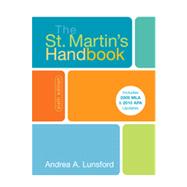
The St. Martin's Handbook with 2009 MLA and 2010 Updates
by LunsfordEdition:
6th
ISBN13:
9780312664831
ISBN10:
0312664834
Format:
Hardcover
Pub. Date:
7/12/2010
Publisher(s):
Bedford/St. Martin's
List Price: $84.50
Rent Textbook
(Recommended)Term
Due
Price
Short Term
Aug 2
$10.34
Semester
Dec 20
$42.25
Quarter
Sep 17
$38.03
$10.34
Buy Used Textbook
In Stock Usually Ships in 24 Hours.
$1.45
eTextbook
360 day subscription
$47.99
New Textbook
We're Sorry
Sold Out
Questions About This Book?
Why should I rent this book?
Renting is easy, fast, and cheap! Renting from eCampus.com can save you hundreds of dollars compared to the cost of new or used books each semester. At the end of the semester, simply ship the book back to us with a free UPS shipping label! No need to worry about selling it back.
How do rental returns work?
Returning books is as easy as possible. As your rental due date approaches, we will email you several courtesy reminders. When you are ready to return, you can print a free UPS shipping label from our website at any time. Then, just return the book to your UPS driver or any staffed UPS location. You can even use the same box we shipped it in!
What version or edition is this?
This is the 6th edition with a publication date of 7/12/2010.
What is included with this book?
- The Used copy of this book is not guaranteed to inclue any supplemental materials. Typically, only the book itself is included.
- The Rental copy of this book is not guaranteed to include any supplemental materials. You may receive a brand new copy, but typically, only the book itself.
Summary
Click here to find out more about the 2009 MLA Updates and the 2010 APA Updates . Andrea A. Lunsford's years of experience in the classroom and in the field have given her a unique understanding of how, what, where, and why today's students write. For her research forThe St. Martin's Handbook ongoing for over two decades she has studied thousands of papers by composition students nationwide. Andrea Lunsford's trademark attention to rhetorical choice, language and style, and critical thinking and argument have always madeThe St. Martin's Handbookan accessible and thorough writing resource. Now informed by new research into student writing patterns and featuring expanded and more visual coverage of research, documentation, and writing in any discipline,The St. Martin's Handbookoffers students more help than ever before with meeting the expectations of college work.
Author Biography
ANDREA A. LUNSFORD is Louise Hewlett Nixon Professor of English and director of the Program in Writing and Rhetoric at Stanford University and also teaches at the Bread Loaf School of English. A past chair of CCCC, she has won the major publication awards in both the CCCC and MLA. For Bedford/St. Martin's, she is also the author of Easy Writer (2006), and The Everyday Writer (2005); The Presence of Others (2004) and Everything's an Argument (2007) with John Ruszkiewicz; and Everything's an Argument with Readings (2007) with John Ruszkiewicz and Keith Walters.
EDITORIAL ADVISERS:
Nora Bacon, University of Nebraska at Omaha
Rick Cole, Boston University
Judith M. Davis, Hampton University
Christy Desmet, University of Georgia
Judith G. Gardner, University of Texas at San Antonio
Sara Jameson, Oregon State University
Michael A. Keller, South Dakota State University
Winnie M. Kenney, Southwestern Illinois College
Heidi L. Kolk, Washington University, St. Louis
Carole P. Lane, University of Arkansas, Fayetteville
Stephen M. Levin, Georgia Institute of Technology
Annie Perkins, Norfolk State University
Eileen B. Seifert, DePaul University
Anne E. Raines, University of Arkansas, Fayetteville
Table of Contents
PART I. THE ART AND CRAFT OF WRITING
1. Expectations for College Writing
2. Reading, Writing, and Research
3. Considering Rhetorical Situations
4. Thinking Visually
5. Exploring, Planning, and Drafting
6. Developing Paragraphs
7. Reviewing, Revising, and Editing
8. Working with Others
PART II. CRITICAL THINKING AND ARGUMENT
9. Analyzing Arguments
10. Considering Visual Arguments
11. Constructing Arguments
PART III. DOING RESEARCH AND USING SOURCES
12. Preparing for a Research Project
13. Conducting Research
14. Evaluating Sources and Taking Notes
15. Integrating Sources into Your Writing
16. Acknowledging Sources and Avoiding Plagiarism
17. Writing a Research Project
18. MLA Documentation
19. APA Documentation
20. Chicago Documentation
21. CSE Documentation
PART IV. PRINT, ELECTRONIC, AND OTHER MEDIA
22. Computer Basics
23. Document Design
24. Online Texts
25. Oral and Multimedia Presentations
PART V. EFFECTIVE LANGUAGE
26. Writing to the World
27. Language That Builds Common Ground
28. Language Variety
29. Word Choice
30. Dictionaries, Vocabulary, and Spelling
PART VI. SENTENCE: GRAMMAR
31. Grammatical Sentences
32. Verbs
33. Subject-Verb Agreement
34. Pronouns
35. Adjectives and Adverbs
PART VII. SENTENCE: CLARITY
36. Shifts
37. Parallelism
38. Comma Splices and Fused Sentences
39. Sentence Fragments
40. Modifier Placement
41. Consistent and Complete Structures
PART VIII. SENTENCE: STYLE
42. Effective Sentences
43. Coordination and Subordination
44. Varied Sentences
45. Memorable Prose
PART IX. PUNCTUATION
46. Commas
47. Semicolons
48. End Punctuation
49. Apostrophes
50. Quotation Marks
51. Other Punctuation Marks
PART X. MECHANICS
52. Capitals
53. Abbreviations and Numbers
54. Italics
55. Hyphens
PART XI. FOR MULTILINGUAL WRITERS
56. Writing for a U.S. Academic Audience
57. Clauses and Sentences
58. Nouns and Noun Phrases
59. Verbs and Verb Phrases
60. Prepositions and Prepositional Phrases
PART XII. ACADEMIC AND PROFESSIONAL WRITING
61. Understanding Disciplinary Discourse
62. Writing for the Humanities
63. Writing for the Social Sciences
64. Writing for the Natural and Applied Sciences
65. Writing for Business
66. Essay Examinations and Portfolios
1. Expectations for College Writing
2. Reading, Writing, and Research
3. Considering Rhetorical Situations
4. Thinking Visually
5. Exploring, Planning, and Drafting
6. Developing Paragraphs
7. Reviewing, Revising, and Editing
8. Working with Others
PART II. CRITICAL THINKING AND ARGUMENT
9. Analyzing Arguments
10. Considering Visual Arguments
11. Constructing Arguments
PART III. DOING RESEARCH AND USING SOURCES
12. Preparing for a Research Project
13. Conducting Research
14. Evaluating Sources and Taking Notes
15. Integrating Sources into Your Writing
16. Acknowledging Sources and Avoiding Plagiarism
17. Writing a Research Project
18. MLA Documentation
19. APA Documentation
20. Chicago Documentation
21. CSE Documentation
PART IV. PRINT, ELECTRONIC, AND OTHER MEDIA
22. Computer Basics
23. Document Design
24. Online Texts
25. Oral and Multimedia Presentations
PART V. EFFECTIVE LANGUAGE
26. Writing to the World
27. Language That Builds Common Ground
28. Language Variety
29. Word Choice
30. Dictionaries, Vocabulary, and Spelling
PART VI. SENTENCE: GRAMMAR
31. Grammatical Sentences
32. Verbs
33. Subject-Verb Agreement
34. Pronouns
35. Adjectives and Adverbs
PART VII. SENTENCE: CLARITY
36. Shifts
37. Parallelism
38. Comma Splices and Fused Sentences
39. Sentence Fragments
40. Modifier Placement
41. Consistent and Complete Structures
PART VIII. SENTENCE: STYLE
42. Effective Sentences
43. Coordination and Subordination
44. Varied Sentences
45. Memorable Prose
PART IX. PUNCTUATION
46. Commas
47. Semicolons
48. End Punctuation
49. Apostrophes
50. Quotation Marks
51. Other Punctuation Marks
PART X. MECHANICS
52. Capitals
53. Abbreviations and Numbers
54. Italics
55. Hyphens
PART XI. FOR MULTILINGUAL WRITERS
56. Writing for a U.S. Academic Audience
57. Clauses and Sentences
58. Nouns and Noun Phrases
59. Verbs and Verb Phrases
60. Prepositions and Prepositional Phrases
PART XII. ACADEMIC AND PROFESSIONAL WRITING
61. Understanding Disciplinary Discourse
62. Writing for the Humanities
63. Writing for the Social Sciences
64. Writing for the Natural and Applied Sciences
65. Writing for Business
66. Essay Examinations and Portfolios
CART


