
More New and Used
from Private Sellers
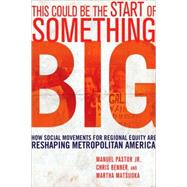
This Could Be the Start of Something Big : How Social Movements for Regional Equity Are Reshaping Metropolitan America
by Pastor, Manuel, Jr.; Benner, Chris; Matsuoka, MarthaISBN13:
9780801474620
ISBN10:
0801474620
Format:
Paperback
Pub. Date:
3/1/2009
Publisher(s):
Cornell Univ Pr
List Price: $21.00
Rent Textbook
(Recommended)Term
Due
Price
Short Term
Aug 2
$9.45
Semester
Sep 30
$11.55
Quarter
Aug 21
$10.50
$9.45
Buy Used Textbook
Usually Ships in 3-5 Business Days
$14.39
eTextbook
We're Sorry
Not Available
New Textbook
We're Sorry
Sold Out
Questions About This Book?
Why should I rent this book?
Renting is easy, fast, and cheap! Renting from eCampus.com can save you hundreds of dollars compared to the cost of new or used books each semester. At the end of the semester, simply ship the book back to us with a free UPS shipping label! No need to worry about selling it back.
How do rental returns work?
Returning books is as easy as possible. As your rental due date approaches, we will email you several courtesy reminders. When you are ready to return, you can print a free UPS shipping label from our website at any time. Then, just return the book to your UPS driver or any staffed UPS location. You can even use the same box we shipped it in!
What version or edition is this?
This is the edition with a publication date of 3/1/2009.
What is included with this book?
- The Used copy of this book is not guaranteed to inclue any supplemental materials. Typically, only the book itself is included.
- The Rental copy of this book is not guaranteed to include any supplemental materials. You may receive a brand new copy, but typically, only the book itself.
Author Biography
Manuel Pastor Jr. (left) is Professor of Geography and American Studies Ethnicity and Director of the Program for Environmental and Regional Equity at the University of Southern California. He is the coauthor of books including Up Against the Sprawl and Regions That Work. Chris Benner (right) is Chair of the Community Development Graduate Group and Associate Professor of Community and Regional Development at the University of California Davis. He is the author of Work in the New Economy. Benner is the coauthor (with Manuel Pastor Jr. and Laura Leete) of Staircases or Treadmills. Martha Matsuoka (center) is Assistant Professor in the Urban and Environmental Policy Department at Occidental College.
Table of Contents
| Acknowledgments | p. ix |
| Something's Happening Here | p. 1 |
| Unpacking Regional Equity | p. 22 |
| The Landscape of Social Movement Regionalism | p. 59 |
| Coming Back Together in Los Angeles | p. 107 |
| Making Regional Equity Work | p. 144 |
| Moving on Up | p. 188 |
| References | p. 219 |
| Index | p. 241 |
| Table of Contents provided by Ingram. All Rights Reserved. |
Excerpts
For nearly two decades, progressives have been dismayed by the steady rise of the right in U.S. politics. Often lost in the gloom and doom about American politics is a striking and sometimes underanalyzed phenomenon: the resurgence of progressive politics and movements at a local level. Across the country, urban coalitions, including labor, faith groups, and community-based organizations, have come together to support living wage laws and fight for transit policies that can move the needle on issues of working poverty. Just as striking as the rise of this progressive resurgence has been its reception among unlikely allies. In places as diverse as Chicago, Atlanta, and San Jose, the usual business resistance to pro-equity policies has changed, particularly when it comes to issues like affordable housing and more efficient transportation systems. To see this change and its possibilities requires that we recognize a new thread running through many local efforts: a perspective and politics that emphasizes "regional equity."Manuel Pastor Jr., Chris Benner, and Martha Matsuoka offer their analysis with an eye toward evaluating what has and has not worked in various campaigns to achieve regional equity. The authors show how momentum is building as new policies addressing regional infrastructure, housing, and workforce development bring together business and community groups who share a common desire to see their city and region succeed. Drawing on a wealth of case studies as well as their own experience in the field, Pastor, Benner, and Matsuoka point out the promise and pitfalls of this new approach, concluding that what they term social movement regionalism might offer an important contribution to the revitalization of progressive politics in America
CART


