
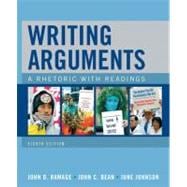
Writing Arguments : A Rhetoric with Readings
by Ramage, John D.; Bean, John C.; Johnson, June C9780205648368
Rent Textbook
(Recommended)Buy Used Textbook
Buy New Textbook
eTextbook
180 day subscription
Questions About This Book?
- The New copy of this book will include any supplemental materials advertised. Please check the title of the book to determine if it should include any CDs, lab manuals, study guides, etc.
- The Used copy of this book is not guaranteed to inclue any supplemental materials. Typically, only the book itself is included.
- The Rental copy of this book is not guaranteed to include any supplemental materials. You may receive a brand new copy, but typically, only the book itself.
Customer Reviews
by


Summary
The market-leading guide to arguments, Writing Arguments ,8/e has proven highly successful in teaching readers to read arguments critically and to produce effective arguments of their own.
Argument is a part of our daily lives. Whether we use or are confronted by it through the written or the spoken word, we rely on and encounter it often. Yet what exactly constitutes an effective argument? How do we construct one? And how are we able to recognize an ineffective argument? These topics, and many more, are the focus of this book on writing arguments. This book presents four approaches to argument: the enthymeme, Toulmin's system of analyzing arguments, stasis theory on categories of claims, and the three classical appeals of logos, pathos and ethos.
With a strong focus on the argument as a social act, the book treats the argument as a means of clarification, truth-seeking and persuasion, thereby highlighting the power of debate and dialectic. Writers, teachers, debaters, lawyers, and others using argument.
Table of Contents
| Preface | |
| Acknowledgments | |
| Overview of Argument | |
| Argument: An Introduction | |
| What Do We Mean by Argument? | |
| Argument Is Not a Fight or a Quarrel | |
| Argument Is Not Pro-Con Debate | |
| Arguments Can Be Explicit or Implicit | |
| Let the Facts Decide, Not Fear | |
| The Defining Features of Argument | |
| Argument Requires Justification of Its Claims | |
| Argument Is Both a Process and a Product | |
| Argument Combines Truth Seeking and Persuasion | |
| Argument and the Problem of Truth | |
| A Successful Process of Argumentation: The Well-Functioning Committee Gordon Adams (student) | |
| ldquo;Petition to Waive the University Mathematics Requirementrdquo; | |
| Conclusion | |
| Argument as Inquiry: Reading and Exploring | |
| Finding Issues to Explore | |
| Do Some Initial Brainstorming | |
| Be Open to the Issues All Around You | |
| Explore Ideas by Freewriting | |
| Explore Ideas by Idea-Mapping | |
| Explore Ideas by Playing the Believing and Doubting | |
| Game Placing Texts in a Rhetorical Context | |
| Genres of Argument | |
| Cultural Contexts: Who Writes Arguments and Why? | |
| Analyzing Rhetorical | |
| Context and Genre Reading to Believe an Argumentrsquo;s Claims | |
| Amnesty? | |
| Summary Writing as a Way of Reading to Believe | |
| Practicing Believing: Willing Your Own Belief in the Writerrsquo;s Views | |
| Reading to Doubt | |
| Thinking Dialectically | |
| Questions to Stimulate Dialectic Thinking | |
| Why Blame Mexico? | |
| Three Ways to Foster Dialectic Thinking | |
| Conclusio | |
| Table of Contents provided by Publisher. All Rights Reserved. |
CART


