

rent-now

Rent More, Save More! Use code: ECRENTAL

5% off 1 book, 7% off 2 books, 10% off 3+ books

9780198909422

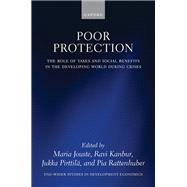
Poor Protection The Role of Taxes and Social Benefits in the Developing World During Crises

by Jouste, Maria; Kanbur, Ravi; Pirttilä, Jukka; Rattenhuber, Pia
  • ISBN13:

    9780198909422

  • ISBN10:

    019890942X

  • eBook ISBN(s):

    9780198909446

  • Format: Hardcover
  • Copyright: 2026-02-06
  • Publisher: Oxford University Press
  • Purchase Benefits
List Price: $138.66 Save up to $53.67
  • Buy New
    $138.52
    Add to Cart Free Shipping Icon Free Shipping

    NOT YET PRINTED. PLACE AN ORDER AND WE WILL SHIP IT AS SOON AS IT ARRIVES.

Summary

An open access title available under the terms of a CC BY-NC-SA 3.0 IGO licence. It is free to read at Oxford Academic and offered as a free PDF download from OUP and selected open access locations.

This book examines the role of social protection and taxation systems in developing countries during times of crises. The main objective of the work is to promote understanding about proper crisis response, and the way social protection and tax systems can be made more sustainable to support countries' paths through and out of economic crises. While there is a vast body of literature evaluating social protection programmes in general, few of these focus on episodes of crisis. During the COVID-19 pandemic, the number and scale of social protection programmes increased rapidly around the globe, but many developing countries lacked a systematic approach to social protection and taxation.

Crises have a devastating effect on employment, incomes, and livelihoods. These impacts are more dangerous when people are already in a vulnerable position. This has become very clear during the latest worldwide crises, including the sharp rise in food and fuel prices. Armoured with comprehensive policies and systems for social protection and taxation, developing countries could enable automatic and speedy assistance when crises hit across the entire income distribution. Analogously to the currently standard financial stress testing in anticipation of crises, thorough stress testing of social protection and tax policies is also of crucial importance.

Poor Protection explores to what extent tax-benefit systems can act as automatic stabilizers in a developing country context during crises, and how they can help provide the fiscal space necessary to cushion at least the most detrimental developments in terms of inequality.

Author Biography

Maria Jouste, Research Associate, United Nations University World Institute for Development Economics Research (UNU-WIDER),Ravi Kanbur, Cornell University, T. H. Lee Professor of World Affairs and Economics,Jukka Pirttilä, Professor of Public Economics, University of Helsinki and VATT Institute for Economic Research,Pia Rattenhuber, Research Fellow, United Nations University World Institute for Development Economics Research (UNU-WIDER)

Maria Jouste is a research associate at UNU-WIDER. She holds a PhD in economics from the University of Turku. Her research interest is in development and public economics, focusing on taxation and social protection in developing countries. She uses both empirical and microsimulation methods for the evaluation of policy-relevant research questions, and has experience in curating and employing large administrative tax data in collaboration with African revenue authorities.


Ravi Kanbur is T. H. Lee Professor of World Affairs and Economics at Cornell University and Co-Chair of the Food Systems Economics Commission. He has served on the senior staff of the World Bank including as Chief Economist for Africa and has published work in leading economics journals. He has previously held positions as Chair of the Board of United Nations University-World Institute for Development Economics Research, member of the OECD High-Level Expert Group on the Measurement of Economic Performance, President of the Human Development and Capability Association, President of the Society for the Study of Economic Inequality.


Jukka Pirttilä is Professor of Public Economics at the University of Helsinki and VATT Institute for Economic Research. He also serves as the deputy director of Helsinki Graduate School of Economics and as a Non-Resident Senior Research Fellow at UNU-WIDER. He conducts research on topics in public economics, especially tax policies, with a special reference to taxation in developing countries.


Pia Rattenhuber is a research fellow at UNU-WIDER. She works in the fields of public, development, and labour economics, specializing in redistribution policies. She leads UNU-WIDER's work on tax-benefit microsimulation in the SOUTHMOD project. She holds a PhD from Free University Berlin and previously worked for the OECD (in the Department of Labour and Social Affairs), the German Ministry of Economics, and the German Institute of Economic Research (DIW Berlin).

Table of Contents

1. Introduction: Protecting the poor and vulnerable when crises are the New Normal, Jukka Pirttilä, Maria Jouste, Ravi Kanbur, and Pia Rattenhuber2. Strengthening resilience: Investigating the effectiveness of social protection and tax policies in cushioning income and poverty impacts amidst crises in low- and middle-income countries, Rodrigo Oliveira, Jesse Lastunen, Pia Rattenhuber, Melissa Samarin, and Adnan ShahirPart I. Performance of tax-benefit systems during crises3. The impact of social protection on poverty through normal times and times of crisis: Evidence from Ghana, Mozambique, Tanzania, Uganda, and Zambia, Katrin Gasior, Iva V. Tasseva, and Gemma Wright4. Performance of tax-benefit systems during the COVID-19 pandemic in sub-Saharan Africa: A comparative perspective, Jesse Lastunen, Adnan Shahir, Pia Rattenhuber, Kwabena Adu-Ababio, and Rodrigo C. Oliveira5. The role of taxes and benefits in protecting household incomes during the COVID-19 pandemic: An analysis of seven Latin American countries, David Rodríguez, H. Xavier Jara, Mariana Dondo, Cristina Arancibia, David Macas, Rebeca Riella, Joana Urraburu, Linda Llamas, Luis Huesca, Javier Torres, and Rodrigo Chang6. The cushioning effects of tax-benefit policies in Vietnam during the COVID-19 pandemic, Antoine de Mahieu and Jesse LastunenPart II. Income developments and specific politics during COVID-197. The effect of wage subsidies on job retention: Evidence from South Africa during the COVID-19 pandemic, Timothy Köhler, Robert Hill, and Haroon Bhorat8. The impact of COVID-19 lockdowns and aid packages in Vietnam, Cuong Viet Nguyen9. Top earnings and inequality during the COVID-19 pandemic in Ecuador, Olivier Bargain, Paul Carillo-Maldonado, and H. Xavier JaraPart III. Looking ahead10. Social protection floor gaps and pandemic relief: Embracing universalism?, Annalena Oppel11. The potential of universal basic income schemes to buffer shocks: Comparing Uganda and Zambia during COVID-19, Enrico Nichelatti, Maria Jouste, and Pia Rattenhuber12. Targeted versus universal benefits: Poverty reduction performance in times of crisis, Adnan Shahir, Ravi Kanbur, Jukka Pirttilä, and Pia Rattenhuber13. Optimal tax rates for Zambia in the COVID-19 pandemic period, Dingquan Miao, Ravi Kanbur, and Jukka PirttiläPart IV. Summary and policy takeaways14. Summary, Jukka Pirttilä, Maria Jouste, Ravi Kanbur, and Pia Rattenhuber15. Policy takeaways, Jukka Pirttilä, Maria Jouste, Ravi Kanbur, and Pia Rattenhuber

Supplemental Materials

What is included with this book?

The New copy of this book will include any supplemental materials advertised. Please check the title of the book to determine if it should include any access cards, study guides, lab manuals, CDs, etc.

The Used, Rental and eBook copies of this book are not guaranteed to include any supplemental materials. Typically, only the book itself is included. This is true even if the title states it includes any access cards, study guides, lab manuals, CDs, etc.

Rewards Program