

rent-now

Rent More, Save More! Use code: ECRENTAL

5% off 1 book, 7% off 2 books, 10% off 3+ books

9780471490166

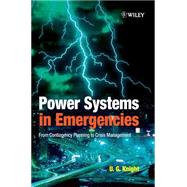
Power Systems in Emergencies From Contingency Planning to Crisis Management

by Knight, U. G.
  • ISBN13:

    9780471490166

  • ISBN10:

    0471490164

  • Edition: 1st
  • Format: Hardcover
  • Copyright: 2001-07-16
  • Publisher: WILEY
  • Purchase Benefits
  • Free Shipping Icon Free Shipping On Orders Over $35!
    Your order must be $35 or more to qualify for free economy shipping. Bulk sales, PO's, Marketplace items, eBooks and apparel do not qualify for this offer.
  • eCampus.com Logo Get Rewarded for Ordering Your Textbooks! Enroll Now
List Price: $285.81 Save up to $0.29
  • Buy New
    $285.52
    Add to Cart Free Shipping Icon Free Shipping

    PRINT ON DEMAND: 2-4 WEEKS. THIS ITEM CANNOT BE CANCELLED OR RETURNED.

Summary

As modern society has become increasingly reliant on electricity, disturbances to the power supply system have become a worldwide industry concern. The range and impact of disturbances are addressed in this comprehensive account of the planning, operation and control of power systems during emergencies. * The impact of a full range of power system emergency situations from adverse weather conditions and natural disasters to equipment failures, human errors and industrial action. * Detailed coverage of the procedures, organisation, training and equipment provided by utilities in order to contain the incidence and impact of disturbances, both sudden and predicted. * Survey of the measures adopted to restore electricity supply from various levels of failure. * The development of abnormal operating conditions: descriptions of actual power system failures and their impacts. * Discussion of the costs and benefits associated with emergency control. * Emergency control in the future - the impact of industry restructuring and deregulation and the new challenges facing utilities and their staff. Offering a clear and concise treatment of the cause, effect and prevention of power system emergencies, this timely book will appeal to utility managers, power engineers, consultants and practitioners involved in, and reliant upon, the electricity supply industry.

Author Biography

U. G. Knight is the author of Power Systems in Emergencies: From Contingency Planning to Crisis Management, published by Wiley.

Table of Contents

Preface xiii
Introduction and Contents
1(6)
Review of Contents
1(5)
General Approach of the Book
6(1)
Disturbances in Power Systems and their Effects
7(28)
Sudden Disturbance
7(3)
Weather
7(1)
Environment
8(1)
Balance between Demand and Generation
9(1)
Plant Failure
9(1)
Human Error
10(1)
Predictable Disturbances
10(3)
Shortage of Plant Capacity
11(1)
Shortage of Fuel
11(1)
Shortage of `Ancillary' Supplies
12(1)
Shortage of Operating Staff
12(1)
Shortage of Control Staff
12(1)
Forms of System Failure
13(13)
Thermal Overloads
14(1)
Switchgear Ratings, Excessive System Fault Levels
14(1)
Voltage Outside Limits
15(4)
Frequency Outside Limits
19(1)
Steady State, Transient and Dynamic Stability
20(1)
Voltage Instability
21(5)
Analysis Techniques
26(7)
Steady State Flows and Voltages
26(2)
Fault Levels
28(1)
Transient Stability
28(4)
Dynamic Stability
32(1)
Medium and Long-term Stability
33(1)
Trends in the Development of Analytical Techniques
33(2)
References
34(1)
Further Reading
34(1)
Some General Aspects of Emergency Control
35(18)
Definitions and Concepts used in Emergency Control
35(4)
Definitions
35(1)
System States
36(1)
Objectives
37(1)
System States, Contingencies and Types of Control
37(2)
Some Standard Terminology
39(1)
The Effects of Various Types of Fault or Disturbance on System Performance
40(4)
Sudden Deficit of Generation or Equivalent
40(2)
Sudden Deficit of Demand or Equivalent
42(2)
Sudden Loss of Transmission (Not Resulting in an Immediate System Split)
44(1)
Sudden Loss of Transmission (Resulting in a System Split)
44(1)
Typical Pattern of the Development of a Sudden Disturbance
44(2)
Conceptual Forms of Emergency Control
46(4)
Effect of System Structure on the Need for and Implementation of Emergency Control
50(1)
Effect of System Structure on the Form of Emergency Control
51(1)
Design Criteria for Emergency Control Facilities
51(2)
References
52(1)
The Power System and its Operational and Control Infrastructure
53(64)
Structure
53(4)
A Theory on the Evolution of Network Voltages
57(1)
The Functions of Interconnection
57(2)
Exchanges Between Neighbours
58(1)
The Alternatives for Main Transmission
59(4)
The Roles of Direct Current Interconnection and Transmission
62(1)
Security and Quality of Supply in Planning and Operation
63(14)
Standards of Security in Planning
64(3)
Standards of Security in Operation
67(5)
Standards of Quality
72(5)
Timescales in System Operation and Control
77(16)
Operational Planning
78(5)
Extended Real-Time Analysis
83(1)
Real-Time Operation
84(5)
Facilities
89(1)
Post-Event Tasks
90(2)
Operator Training
92(1)
Models Used in Post-Event Tasks
93(1)
SCADA
93(14)
Questions on Functions and Structure
95(3)
Questions on Performance Criteria
98(1)
Information Required at Control Centres
99(1)
Information Sent Out from Control Centres
99(3)
The Human-Computer Interface
102(2)
Availability Requirements for SCADA Systems and their Structure
104(3)
Energy Management Systems
107(1)
Communications and Telemetry
108(3)
Telecommand
111(1)
Distributed Generation
111(1)
Flexible a.c. Transmission Systems (FACTS)
111(6)
Factors Preventing Full Thermal Loading of Circuits in an a.c. Network
112(1)
Some FACTS Devices
113(2)
References
115(1)
Further Reading
116(1)
Measures to Minimize the Impact of Disturbances
117(58)
Factors in Onset, Severity and Propagation of a Disturbance
118(1)
Measures in the Planning Timescale to Minimize the Risk of a Disturbance
119(11)
The Basic Formulation
119(3)
Generation Provisions in the System Plan
122(2)
Measures for Demand Adjustment in the System Plan
124(6)
Measures in the Operational Timescale to Minimize the Risk and Impact of a Disturbance
130(7)
Under-frequency Load Disconnection
130(3)
Other Frequency Control Mechanisms
133(1)
Memoranda and Procedures
133(4)
Special Protection Schemes
137(21)
The Elements of a Special Protection Scheme
139(2)
The Performance of SPS
141(4)
Prevention of Overload and Instability
145(2)
System Application of SPS
147(11)
Reduction in the Spread of Disturbances
158(2)
Rapid Clearance of Faults
159(1)
Sustainable Conditions Following the Initial Fault Clearance
159(1)
Restoration of Normal Conditions
160(1)
Measures to Minimize the Impact of Predictable Disturbances
160(7)
Natural Phenomena
161(1)
Incipient Breakdown of Plant
161(2)
Labour Problems
163(4)
An Approach to Managing Resources
167(2)
The Control Centre
169(6)
SCADA
169(2)
Main, Standby and Backup SCADA/EMS Systems
171(1)
Communications
171(1)
References
172(1)
Further Reading
173(2)
The Natural Environment-Some Disturbances Reviewed
175(38)
Introduction
175(1)
Useful Sources of Information
175(2)
Government and Similarly Sponsored Inquiries
176(1)
Utility Inquiries
176(1)
Annual Reports
176(1)
International and National Surveys
176(1)
The Internet
177(1)
Extreme Environmental Conditions
177(12)
Hurricanes
178(1)
Tornadoes
179(1)
Gales
180(1)
Hail, Snow and Icestorms
180(1)
Earthquakes and Tsunamis
181(1)
Vegetation Brushfires
182(1)
Thunderstorms, Lightning and Overvoltages
183(4)
Floods
187(1)
Geomagnetic Storms
188(1)
Disaster Control
188(1)
Noteworthy Disturbances
189(9)
The Questionnaire
189(1)
An Example (a Complex Fault on a Simple System)
190(1)
Tabular Information on Disturbances
191(1)
Descriptions of Disturbances
191(7)
Incidents
198(13)
UK--August 1981
198(3)
UK--1986
201(1)
UK--October 1987
201(2)
France--1999
203(1)
Scandinavia--1997
204(1)
Malaysia--1996
204(1)
New Zealand--late January--early March 1998
204(3)
Australia--1977
207(1)
Australia--1994
208(1)
USA--July 1986
208(1)
USA--1989
209(1)
USA--September 1989
209(1)
USA--August 1996
209(1)
Canada--January 1998
210(1)
Canada and USA--January 1998
210(1)
USA--January 1998
211(1)
USA--January 1998
211(1)
USA--March 1998
211(1)
Conclusion
211(2)
References
212(1)
Restoration
213(18)
Introduction
213(1)
The Range of Disturbed System Conditions
213(2)
Some General Issues in Restoration
215(1)
Recovery from an Abnormal Operating Situation, Local Islanding or Localized Loss of Demand
215(2)
Checking System Security during the Restoration Process
216(1)
The `Black Start' Situation
217(4)
The Generation Demand Balance
218(1)
The System Reactive Balance
219(1)
Status of the Control and Protection Facilities
219(2)
Strategies for Restoration of the Whole System
221(2)
Preparation of the System
222(1)
Rebuilding the Transmission System
222(1)
Aids in the Restoration Process
223(1)
Operational Planning Studies
223(1)
Expert Systems
224(1)
Automatic Systems Switching
224(1)
Problems Found in Restoration
224(2)
Analysis, Simulation and Modelling in Blackstart
226(2)
In-depth Analysis
226(1)
Routine but Complex Analysis
227(1)
Operation Studies in the Event
228(1)
Restoration from a Foreseen Disturbance
228(3)
Further Reading
228(3)
Training and Simulators for Emergency Control
231(20)
Introduction
231(1)
Training in General
231(1)
The Need for Operator Training
232(1)
The Content of Training
233(1)
Forms of Training
234(2)
Father-Son Tuition
234(1)
Group Discussion
234(1)
Training Courses
234(1)
Organization of Training Courses
235(1)
Assistance in Commissioning
235(1)
Self-tuition
235(1)
Training Simulators
236(10)
Outline Specification for a Training Simulator
236(1)
Alternative Forms of Training Simulators
237(2)
Some Commercial Training Simulators
239(5)
The New Generation of Dispatch Training Simulators
244(2)
The Use of Dispatch Training Simulators in Practice
246(1)
Conclusion
247(4)
References
247(1)
Further Reading
248(3)
Plant Characteristics and Control Facilities for Emergency Control, and Benefits to be Obtained
251(14)
Introduction
251(1)
The Characteristics and Facilities Required for Emergency Control
252(1)
Generating Plant
252(1)
Transmission Plant
252(1)
Overhead Lines
253(1)
Cables
253(1)
The System and Demand
253(3)
Configuration
254(1)
Demand
255(1)
Adjustment of Active Power Flow
255(1)
Adjustment of Reactive Power Infeeds
255(1)
System Control Costs for Emergencies
256(2)
Indirect Costs
258(1)
The Benefits of Emergency Control
258(3)
Qualitative Aspects
258(3)
Quantitative Aspects
261(1)
Is Emergency Control Worthwhile?
262(3)
References
263(1)
Further Reading
263(2)
Systems and Emergency Control in the Future
265(48)
Introduction
265(1)
Changes in Organization
266(7)
Restructuring, Unbundling and Emergency Control
273(21)
Regulatory Aspects
275(19)
Facilities for Emergency Control in the Future
294(13)
Superconductivity
307(1)
Contingency Planning and Crisis Management
308(5)
References
309(2)
Additional Reading
311(2)
Appendix 1 Some Major Interconnected Systems Around the World: Existing and Possible Developments 313(10)
Western Europe
313(1)
England, Wales and Scotland (as at the mid-late 1990s)
314(2)
Scandinavia
316(1)
Part Central and Eastern Europe
316(1)
A Baltic Ring
317(1)
Central Europe
318(1)
North America
318(1)
India
319(1)
Middle East and North Africa
319(1)
Peoples' Republic of China
319(1)
Africa
319(2)
South America
321(1)
Central American Power Grid
321(1)
Information Sources
321(2)
Appendix 2 Glossary of Useful Terms 323(30)
References
350(3)
Appendix 3 Some Useful Mathematical and Modelling Techniques in Power Systems Studies 353(18)
A3.1 Linear Programming
353(2)
A3.2 Some Special Forms and Extensions of Linear Programming
355(3)
A3.2.1 Transportation
355(2)
A3.2.2 Integer Linear Programming
357(1)
A3.2.3 Quadratic Programming
358(1)
A3.3 Non-linear Programming
358(3)
A3.3.1 The Indirect Approach Using Lagrangian and Kuhn--Tucker Multipliers
358(2)
A3.3.2 The Direct Approach Using Gradient Methods
360(1)
A3.4 Dynamic Programming
361(2)
A3.5 Operating Costs
363(3)
A3.6 Power System Analysis
366(2)
A3.6.1 Power Flows and Voltages
366(2)
A3.7 The d.c. Approximation
368(3)
References
369(1)
Further Reading
369(2)
Index 371

Supplemental Materials

What is included with this book?

The New copy of this book will include any supplemental materials advertised. Please check the title of the book to determine if it should include any access cards, study guides, lab manuals, CDs, etc.

The Used, Rental and eBook copies of this book are not guaranteed to include any supplemental materials. Typically, only the book itself is included. This is true even if the title states it includes any access cards, study guides, lab manuals, CDs, etc.

Rewards Program