
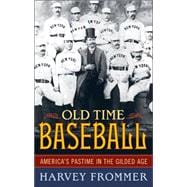
A historical account of baseball and its key contributors describes its 1842 invention by a British sea captain's descendant, its early first games on a vacant lot in New York, and the rise of professional leagues. | Acknowledgments |
|
ix | |
| Introduction |
|
xi | |
| 1 The March of Baseball Time |
|
1 | (24) |
|
A day-by-day, month-by-month, year-by-year, decade-by-decade look at baseball in the 19th century from the 1834 first book of instructions through Alexander Cartwright's game, players, ballparks, major characters and into the new century. |
|
|
| 2 Roots |
|
25 | (34) |
|
Debunking one more time the Doubleday myth and giving credit to Alexander Cartwright as the "Father of Modern Baseball." The game evolves. Baseball and the Civil War, the Cincinnati Red Stockings—the first "professional team," the National Association, the birth of the National League. |
|
|
| 3 The Backdrop |
|
59 | (28) |
|
All matter of unusual one-of-a-kind facts and stories about ballparks, rules, umpires, women in baseball, equipment and uniforms, bats, the baseball. |
|
|
| 4 The National League and Its Competitors |
|
87 | (32) |
|
"Father of the National League" William Hulbert. The first season of 1876. The challengers: the American Association, Union Association, the Brotherhood and the Players League, postseason baseball, milestone moments on the field, the coming of the new American League. |
|
|
| 5 Tintypes: A Sampler |
|
119 | (44) |
|
Some of the great players and memorable characters of that time: Cap Anson, Dan Brouthers, Jesse Burkett, Fred Clarke, John Clarkson, Jimmy Collins, Roger Connor, Candy Cummings, Ed Delahanty, Hugh Duffy, Buck Ewing, Pud Galvin, Clark Griffith, Billy Hamilton, Hughie Jennings, Tim Keefe, "Wee Willie" Keeler, Joe Kelley, King Kelly, John McGraw, John Alexander "King Bid" McPhee, Kid Nichols, Jim O'Rourke, Charley Radbourn, Wilbert Robinson, Amos Rusie, Albert Spalding, Bobby Wallace, John Montgomery Ward, George Wright, Harry Wright, Cy Young. |
|
|
| 6 The Great Teams |
|
163 | (14) |
|
A sampler of some of the best of the best: the Chicago White Stockings, the Providence Grays, the New York Giants, the St. Louis Browns, the Baltimore Orioles, the Boston Beaneaters. |
|
|
| Epilogue |
|
177 | (2) |
|
Baseball's past is as real as its present, always close to the surface, always worth celebrating. |
|
|
| Appendixes |
|
179 | (10) |
|
For the record: National League pennant winners. Home run champions. Batting champions. Base-stealing champions. Pitching leaders. 1890's leaders. National Association of Base Ball Players champions. Home run record evolution. |
|
|
| About the Author |
|
189 | |
Much has been made of the decline of the national pastime and all its modern sins: overpaid players, bottom-line-obsessed owners, greedy agents and riotous fans are just a few complaints. But as baseball historian Frommer illustrates in this wonderful book, many of the elements of Major League Baseball as it's now played can be traced to its 19th-century roots. For starters, Frommer dispels the myth that American baseball was founded in Cooperstown, N.Y., by Abner Doubleday and gives credit to 22-year-old Alexander Joy Cartwright Jr., who, along with friends, played what was perhaps the first game on a vacant Manhattan lot in 1842. It wasn't until June 19, 1846, that the sport's first "official" game was played between Cartwright's Knickerbockers Base Ball club and the New York Nine (the Knickerbockers lost, 23-1). By 1865, the game was big enough for a team to receive an invitation to visit President Andrew Johnson. But perhaps more importantly, around the time of the Civil War, baseball was a unifying force: after Gen. Robert E. Lee surrendered, Union and Confederate troops played a friendly game. Reading this book is a reminder of how little baseball--and the pleasure derived from it--has changed. B&w photos. (Feb.) [Page 53]. Copyright 2005 Reed Business Information.
|