
More New and Used
from Private Sellers
List Price: $50.00
Rent Textbook
(Recommended)Term
Due
Price
Short Term
Aug 2
$9.84
Semester
Dec 20
$25.00
Quarter
Sep 17
$22.50
$9.84
Buy Used Textbook
In Stock Usually Ships in 24 Hours.
$20.83
eTextbook
We're Sorry
Not Available
New Textbook
We're Sorry
Sold Out
Questions About This Book?
Why should I rent this book?
Renting is easy, fast, and cheap! Renting from eCampus.com can save you hundreds of dollars compared to the cost of new or used books each semester. At the end of the semester, simply ship the book back to us with a free UPS shipping label! No need to worry about selling it back.
How do rental returns work?
Returning books is as easy as possible. As your rental due date approaches, we will email you several courtesy reminders. When you are ready to return, you can print a free UPS shipping label from our website at any time. Then, just return the book to your UPS driver or any staffed UPS location. You can even use the same box we shipped it in!
What version or edition is this?
This is the 6th edition with a publication date of 7/9/2007.
What is included with this book?
- The Used copy of this book is not guaranteed to inclue any supplemental materials. Typically, only the book itself is included.
- The Rental copy of this book is not guaranteed to include any supplemental materials. You may receive a brand new copy, but typically, only the book itself.
Related Products
Summary
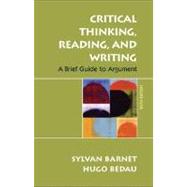
Critical Thinking, Reading, and Writingis a compact but thorough guide to critical thinking and argumentation. Comprising the text portion of the widely adoptedCurrent Issues and Enduring Questions, it draws on the authors' dual expertise in effective persuasive writing and rigorous critical thinking. It helps students move from critical thinking to argumentative and researched writing. With comprehensive coverage of classic and contemporary approaches to argument, including Aristotle, Toulmin, and a range of alternative views, it is an extraordinarily versatile text. This affordable guide can stand alone or supplement a larger anthology of readings.Critical Thinking, Reading, and Writinghas been revised to address current student interests and trends in argument, research, and writing.
Author Biography
SYLVAN BARNET, professor of English and former director of writing at Tufts University, is the most prolific and consistently successful college English textbook author of the past 30 years. His several texts on writing and his numerous anthologies for introductory composition and literature courses have remained leaders in their field through many editions.
HUGO BEDAU, professor of philosophy at Tufts University, has served as chair of the philosophy department and chair of the university’s committee on College Writing. An internationally respected expert on the death penalty, and on moral, legal, and political philosophy, he has written or edited a number of books on these topics. He is the author of Thinking and Writing about Philosophy, Second Edition (Bedford/St. Martin’s, 2002).
Table of Contents
PART I. CRITICAL THINKING AND READING
1. Critical Thinking
Thinking about Drivers' Licenses and Photographic Identification
Thinking about Another Issue Concerning Drivers' Licenses: Imagination, Analysis, Evaluation
Writing as a Way of Thinking
A CHECKLIST FOR CRITICAL THINKING
A Short Essay Illustrating Critical Thinking
Alan Dershowitz, Why Fear National ID Cards?
Examining Assumptions
A CHECKLIST FOR EXAMINING ASSUMPTIONS
]Thinking about Wild Horses
]Deanne Stillman, Last Roundup for Wild Horses
A CHECKLIST FOR EVALUATING LETTERS OF RESPONSE
Letters of Response by Herb Kimsey and Tom Burke
]Luke Saginaw (Student Essay), Why Flag-Burning Ought Not to Be Permitted
Five Exercises in Critical Thinking
2. Critical Reading: Getting Started
Active Reading
Previewing
Skimming: Finding the Thesis
Reading with a Pencil: Underlining, Highlighting, Annotating
ÒThis; Therefore, ThatÓ
First, Second, and Third Thoughts
Summarizing and Paraphrasing
]A Note about Paraphrase and Plagiarism
]Last Words (Almost) About Summarizing
Susan Jacoby, A First Amendment Junkie
Summarizing Jacoby, Paragraph by Paragraph
A CHECKLIST FOR GETTING STARTED
]Gwen Wilde (Student Essay), Why the Pledge of Allegiance Should Be Revised
A Casebook for Critical Reading: Should Some Kinds of Speech Be Censored?
Susan Brownmiller, Let's Put Pornography Back in the Closet
Charles R. Lawrence III, On Racist Speech
Derek Bok, Protecting Freedom of Expression on the Campus
]Stanley Fish, Conspiracy Theories
]Letters of Response By Jonah Seligman, Richard Dimatteo, Miriam Cherkes-Julkowski, Joseph Kyle, and Patrick Ward
Jean Kilbourne, ÒOwn This ChildÓ
Exercise: Letter To The Editor
3. Critical Reading: Getting Deeper Into Arguments
Persuasion, Argument, Dispute
Reason Versus Rationalization
Some Procedures in Argument
Definition
Assumptions
Premises and Syllogisms
Deduction
Sound Arguments
Induction
Evidence
Examples
Authoritative Testimony
Statistics
A CHECKLIST FOR EVALUATING STATISTICAL EVIDENCE
Nonrational Appeals
Satire
Irony
Sarcasm
Humor
Emotional Appeals
A CHECKLIST FOR ANALYZING AN ARGUMENT
Does All Writing Contain Arguments?
An Example: An Argument and a Look at the Writer's Strategies
George F. Will, Being Green at Ben and Jerry's
George F. Wills's Strategies
Arguments for Analysis
Gloria JimŽnez (Student Essay), Against the Odds, and Against the Common Good
Anna Lisa Raya (Student Essay), It's Hard Enough Being Me
Ronald Takaki, The Harmful Myth of Asian Superiority
James Q. Wilson, Just Take Away Their Guns
]Nadya Labi, Classrooms for Sale
]Nadine Strossen, Everyone is Watching You
]E-Mail Responses to Nadine Strossen
]Sally Satel, Death's Waiting List
]Letters of Response By Dorothy H. Hayes, Charles B. Fruit, and Michelle Goodwin
]Paul Kane, A Peaceful Call to Arms
]Letters of Response By Julie E. Dinnerstein, Murray Polner, Joan Z. Greiner, and Joshua Zimmerman
4. Visual Rhetoric: Images as Arguments
Some Uses of Images
Appeals to the Eye
Are Some Images Not Fit to Be Shown?
Exercises: Thinking about Images
Reading Advertisements
A CHECKLIST FOR ANALYZING IMAGES (ESPECIALLY ADVERTISEMENTS)
]Writing About a Political Cartoon
]A CHECKLIST FOR ANALYZING POLITICAL CARTOONS
]Jackson Smith (Student Essay), Pledging Nothing?
Visuals as Aids to Clarity: Maps, Graphs, Tables, and Pie Charts
A Note on Using Visuals In Your Own Paper
]A CHECKLIST FOR CHARTS AND GRAPHS
Additional Images for Analysis
Nora Ephron, The Boston Photographs
PART II. CRITICAL WRITING
5. Writing an Analysis Of an Argument
Analyzing an Argument
Examining the Author's Thesis
Examining the Author's Purpose
Examining the Author's Methods
Examining the Author's Persona
Summary
]A CHECKLIST FOR ANALYZING A TEXT
]An Argument, Its Elements, and a Student's Analysis of the Argument
]Nicholas D. Kristof, For Environmental Balance, Pick Up a Rifle
]Betsy Swinton (Student Essay), Tracking Kristof
]An Analysis of the Student's Analysis
A CHECKLIST FOR WRITING AN ANALYSIS OF AN ARGUMENT
Arguments for Analysis
Jeff Jacoby, Bring Back Flogging
John Irving, Wrestling With Title IX
Peter Singer, Animal Liberation
Jonathan Swift, A Modest Proposal
6. Developing An Argument of Your Own
Planning, Drafting, and Revising an Argument
Getting Ideas
The Thesis
]A CHECKLIST FOR A THESIS STATEMENT
Imagining an Audience
The Audience as Collaborator
]A CHECKLIST FOR IMAGINING AN AUDIENCE
The Title
The Opening Paragraphs
Organizing and Revising The Body of the Essay
The Ending
Two Uses of an Outline
Tone and the Writer's Persona
We, One, Or I?
Avoiding Sexist Language
A CHECKLIST FOR ATTENDING TO THE NEEDS OF THE AUDIENCE
Peer Review
A PEER REVIEW CHECKLIST FOR A DRAFT OF AN ARGUMENT
A Student's Essay, from Rough
Notes to Final Version
Emily Andrews, Why I Don't Spare ÒSpare ChangeÓ
The Essay Analyzed
Exercise
7. Using Sources
Why Use Sources?
Choosing a Topic
Finding Material
Interviewing Peers and Local Authorities
Finding Quality Information on the Web
Finding Articles Using Library Databases
]Locating Books
Evaluating Sources
A CHECKLIST FOR EVALUATING PRINT SOURCES
A CHECKLIST FOR EVALUATING ELECTRONIC SOURCES
Taking Notes
A Note on Plagiarizing, Paraphrasing, and Using Common Knowledge
A CHECKLIST FOR AVOIDING PLAGIARISM
Compiling an Annotated Bibliography
Writing The Paper
Organizing Your Notes
The First Draft
Later Drafts
Choosing a Tentative Title
The Final Draft
Quoting From Sources
The Use and Abuse of Quotations How to Quote
]A CHECKLIST FOR USING QUOTATIONS RATHER THAN SUMMARIES
Documentation
A Note on Footnotes (and Endnotes)
MLA Format: Citations Within the Text
MLA Format: the List of Works Cited
APA Format: Citations Within the Text
APA Format: The List of References
A CHECKLIST FOR PAPERS USING SOURCES
An Annotated Student Research Paper In MLA Format
Theresa Washington, Why Trials Should Not Be Televised
An Annotated Student Research Paper In APA Format
Laura Deveau, The Role of Spirituality and Religion In Mental Health
PART III. FURTHER VIEWS ON ARGUMENT
8. A Philosopher's View: The Toulmin Model
The Claim
Grounds
Warrants
Backing
Modal Qualifiers
Rebuttals
A Model Analysis Using The Toulmin Method
A CHECKLIST FOR USING THE TOULMIN METHOD
]Putting the Toulmin Method to Work: Responding to an Argument
]Michael S. Dukakis and Daniel J. B. Mitchell, Raise Wages, Not Walls
]Thinking With Toulmin's Method
9. A Logician's View: Deduction, Induction, Fallacies
Deduction
Induction
Observation and Inference
Probability
Mill's Methods
Confirmation, Mechanism, and Theory
Fallacies
]Fallacies of Ambiguity
]Fallacies of Presumption
]Fallacies of Relevance
A CHECKLIST FOR EVALUATING AN ARGUMENT FROM A LOGICAL POINT OF VIEW
Max Shulman, Love Is a Fallacy
10. A Moralist's View: Ways Of Thinking Ethically
Amoral Reasoning
Immoral Reasoning
Moral Reasoning: A Closer Look
Criteria for Moral Rules
A CHECKLIST FOR MORAL REASONING
Peter Singer, Famine, Affluence, and Morality
Garrett Hardin, Lifeboat Ethics: The Case Against Helping The Poor
Randy Cohen, Three Letters (To an Ethicist)
11. A Lawyer's View: Steps Toward Civic Literacy
Civil and Criminal Cases
Trial and Appeal
Decision and Opinion
Majority, Concurring, and Dissenting Opinions
Facts and Law
Balancing Interests
A Word of Caution
A CHECKLIST FOR ANALYZING LEGAL ARGUMENTS
A Casebook on the Law and Society: What Rights Do the Constitution and the Bill of Rights Protect?
William J. Brennan Jr. and William H. Rehnquist, Texas V. Johnson
Byron R. White and John Paul Stevens, New Jersey V. T.L.O.
Harry Blackmun and William H. Rehnquist, Roe V. Wade
12. A Psychologist's View: Rogerian Argument
Rogerian Argument: An Introduction
Carl R. Rogers, Communication: Its Blocking and Its Facilitation
A CHECKLIST FOR ANALYZING ROGERIAN ARGUMENT
]Jane Willy (Student Essay), Is the College Use of American Indian Mascots Racist?
13. A Literary Critic's View: Arguing About Literature
Interpreting
Judging (or Evaluating)
Theorizing
A CHECKLIST FOR AN ARGUMENT ABOUT LITERATURE
Examples: Two Students Interpret Robert Frost's "Mending Wall"
Robert Frost, Mending Wall
Jonathan Deutsch, The Deluded Speaker In Frost's ÒMending WallÓ
Felicia Alonso, The Debate In Robert Frost's "Mending Wall"
Andrew Marvell, To His Coy Mistress
Kate Chopin, The Story of an Hour
Thinking About the Effects of Literature
Plato, "The Greater Part of the Stories Current Today We Shall Have to Reject"
Thinking About Government Funding for the Arts
14. A Forensic View: Oral Presentation and Debate
Standard Debate Format
The Audience
Delivery
The Talk
A CHECKLIST FOR PREPARING FOR A DEBATE
PART IV. A CASEBOOK ON THE STATE AND THE INDIVIDUAL
15. What Is the Ideal Society?
Thomas More, From Utopia
Niccol˜ Machiavelli, From The Prince
Thomas Jefferson, The Declaration of Independence
Elizabeth Cady Stanton, Declaration of Sentiments and Resolutions
Martin Luther King Jr., I Have a Dream
Ursula K. Le Guin, The Ones Who Walk Away From Omelas
Index of Authors and Titles
Index of Terms
1. Critical Thinking
Thinking about Drivers' Licenses and Photographic Identification
Thinking about Another Issue Concerning Drivers' Licenses: Imagination, Analysis, Evaluation
Writing as a Way of Thinking
A CHECKLIST FOR CRITICAL THINKING
A Short Essay Illustrating Critical Thinking
Alan Dershowitz, Why Fear National ID Cards?
Examining Assumptions
A CHECKLIST FOR EXAMINING ASSUMPTIONS
]Thinking about Wild Horses
]Deanne Stillman, Last Roundup for Wild Horses
A CHECKLIST FOR EVALUATING LETTERS OF RESPONSE
Letters of Response by Herb Kimsey and Tom Burke
]Luke Saginaw (Student Essay), Why Flag-Burning Ought Not to Be Permitted
Five Exercises in Critical Thinking
2. Critical Reading: Getting Started
Active Reading
Previewing
Skimming: Finding the Thesis
Reading with a Pencil: Underlining, Highlighting, Annotating
ÒThis; Therefore, ThatÓ
First, Second, and Third Thoughts
Summarizing and Paraphrasing
]A Note about Paraphrase and Plagiarism
]Last Words (Almost) About Summarizing
Susan Jacoby, A First Amendment Junkie
Summarizing Jacoby, Paragraph by Paragraph
A CHECKLIST FOR GETTING STARTED
]Gwen Wilde (Student Essay), Why the Pledge of Allegiance Should Be Revised
A Casebook for Critical Reading: Should Some Kinds of Speech Be Censored?
Susan Brownmiller, Let's Put Pornography Back in the Closet
Charles R. Lawrence III, On Racist Speech
Derek Bok, Protecting Freedom of Expression on the Campus
]Stanley Fish, Conspiracy Theories
]Letters of Response By Jonah Seligman, Richard Dimatteo, Miriam Cherkes-Julkowski, Joseph Kyle, and Patrick Ward
Jean Kilbourne, ÒOwn This ChildÓ
Exercise: Letter To The Editor
3. Critical Reading: Getting Deeper Into Arguments
Persuasion, Argument, Dispute
Reason Versus Rationalization
Some Procedures in Argument
Definition
Assumptions
Premises and Syllogisms
Deduction
Sound Arguments
Induction
Evidence
Examples
Authoritative Testimony
Statistics
A CHECKLIST FOR EVALUATING STATISTICAL EVIDENCE
Nonrational Appeals
Satire
Irony
Sarcasm
Humor
Emotional Appeals
A CHECKLIST FOR ANALYZING AN ARGUMENT
Does All Writing Contain Arguments?
An Example: An Argument and a Look at the Writer's Strategies
George F. Will, Being Green at Ben and Jerry's
George F. Wills's Strategies
Arguments for Analysis
Gloria JimŽnez (Student Essay), Against the Odds, and Against the Common Good
Anna Lisa Raya (Student Essay), It's Hard Enough Being Me
Ronald Takaki, The Harmful Myth of Asian Superiority
James Q. Wilson, Just Take Away Their Guns
]Nadya Labi, Classrooms for Sale
]Nadine Strossen, Everyone is Watching You
]E-Mail Responses to Nadine Strossen
]Sally Satel, Death's Waiting List
]Letters of Response By Dorothy H. Hayes, Charles B. Fruit, and Michelle Goodwin
]Paul Kane, A Peaceful Call to Arms
]Letters of Response By Julie E. Dinnerstein, Murray Polner, Joan Z. Greiner, and Joshua Zimmerman
4. Visual Rhetoric: Images as Arguments
Some Uses of Images
Appeals to the Eye
Are Some Images Not Fit to Be Shown?
Exercises: Thinking about Images
Reading Advertisements
A CHECKLIST FOR ANALYZING IMAGES (ESPECIALLY ADVERTISEMENTS)
]Writing About a Political Cartoon
]A CHECKLIST FOR ANALYZING POLITICAL CARTOONS
]Jackson Smith (Student Essay), Pledging Nothing?
Visuals as Aids to Clarity: Maps, Graphs, Tables, and Pie Charts
A Note on Using Visuals In Your Own Paper
]A CHECKLIST FOR CHARTS AND GRAPHS
Additional Images for Analysis
Nora Ephron, The Boston Photographs
PART II. CRITICAL WRITING
5. Writing an Analysis Of an Argument
Analyzing an Argument
Examining the Author's Thesis
Examining the Author's Purpose
Examining the Author's Methods
Examining the Author's Persona
Summary
]A CHECKLIST FOR ANALYZING A TEXT
]An Argument, Its Elements, and a Student's Analysis of the Argument
]Nicholas D. Kristof, For Environmental Balance, Pick Up a Rifle
]Betsy Swinton (Student Essay), Tracking Kristof
]An Analysis of the Student's Analysis
A CHECKLIST FOR WRITING AN ANALYSIS OF AN ARGUMENT
Arguments for Analysis
Jeff Jacoby, Bring Back Flogging
John Irving, Wrestling With Title IX
Peter Singer, Animal Liberation
Jonathan Swift, A Modest Proposal
6. Developing An Argument of Your Own
Planning, Drafting, and Revising an Argument
Getting Ideas
The Thesis
]A CHECKLIST FOR A THESIS STATEMENT
Imagining an Audience
The Audience as Collaborator
]A CHECKLIST FOR IMAGINING AN AUDIENCE
The Title
The Opening Paragraphs
Organizing and Revising The Body of the Essay
The Ending
Two Uses of an Outline
Tone and the Writer's Persona
We, One, Or I?
Avoiding Sexist Language
A CHECKLIST FOR ATTENDING TO THE NEEDS OF THE AUDIENCE
Peer Review
A PEER REVIEW CHECKLIST FOR A DRAFT OF AN ARGUMENT
A Student's Essay, from Rough
Notes to Final Version
Emily Andrews, Why I Don't Spare ÒSpare ChangeÓ
The Essay Analyzed
Exercise
7. Using Sources
Why Use Sources?
Choosing a Topic
Finding Material
Interviewing Peers and Local Authorities
Finding Quality Information on the Web
Finding Articles Using Library Databases
]Locating Books
Evaluating Sources
A CHECKLIST FOR EVALUATING PRINT SOURCES
A CHECKLIST FOR EVALUATING ELECTRONIC SOURCES
Taking Notes
A Note on Plagiarizing, Paraphrasing, and Using Common Knowledge
A CHECKLIST FOR AVOIDING PLAGIARISM
Compiling an Annotated Bibliography
Writing The Paper
Organizing Your Notes
The First Draft
Later Drafts
Choosing a Tentative Title
The Final Draft
Quoting From Sources
The Use and Abuse of Quotations How to Quote
]A CHECKLIST FOR USING QUOTATIONS RATHER THAN SUMMARIES
Documentation
A Note on Footnotes (and Endnotes)
MLA Format: Citations Within the Text
MLA Format: the List of Works Cited
APA Format: Citations Within the Text
APA Format: The List of References
A CHECKLIST FOR PAPERS USING SOURCES
An Annotated Student Research Paper In MLA Format
Theresa Washington, Why Trials Should Not Be Televised
An Annotated Student Research Paper In APA Format
Laura Deveau, The Role of Spirituality and Religion In Mental Health
PART III. FURTHER VIEWS ON ARGUMENT
8. A Philosopher's View: The Toulmin Model
The Claim
Grounds
Warrants
Backing
Modal Qualifiers
Rebuttals
A Model Analysis Using The Toulmin Method
A CHECKLIST FOR USING THE TOULMIN METHOD
]Putting the Toulmin Method to Work: Responding to an Argument
]Michael S. Dukakis and Daniel J. B. Mitchell, Raise Wages, Not Walls
]Thinking With Toulmin's Method
9. A Logician's View: Deduction, Induction, Fallacies
Deduction
Induction
Observation and Inference
Probability
Mill's Methods
Confirmation, Mechanism, and Theory
Fallacies
]Fallacies of Ambiguity
]Fallacies of Presumption
]Fallacies of Relevance
A CHECKLIST FOR EVALUATING AN ARGUMENT FROM A LOGICAL POINT OF VIEW
Max Shulman, Love Is a Fallacy
10. A Moralist's View: Ways Of Thinking Ethically
Amoral Reasoning
Immoral Reasoning
Moral Reasoning: A Closer Look
Criteria for Moral Rules
A CHECKLIST FOR MORAL REASONING
Peter Singer, Famine, Affluence, and Morality
Garrett Hardin, Lifeboat Ethics: The Case Against Helping The Poor
Randy Cohen, Three Letters (To an Ethicist)
11. A Lawyer's View: Steps Toward Civic Literacy
Civil and Criminal Cases
Trial and Appeal
Decision and Opinion
Majority, Concurring, and Dissenting Opinions
Facts and Law
Balancing Interests
A Word of Caution
A CHECKLIST FOR ANALYZING LEGAL ARGUMENTS
A Casebook on the Law and Society: What Rights Do the Constitution and the Bill of Rights Protect?
William J. Brennan Jr. and William H. Rehnquist, Texas V. Johnson
Byron R. White and John Paul Stevens, New Jersey V. T.L.O.
Harry Blackmun and William H. Rehnquist, Roe V. Wade
12. A Psychologist's View: Rogerian Argument
Rogerian Argument: An Introduction
Carl R. Rogers, Communication: Its Blocking and Its Facilitation
A CHECKLIST FOR ANALYZING ROGERIAN ARGUMENT
]Jane Willy (Student Essay), Is the College Use of American Indian Mascots Racist?
13. A Literary Critic's View: Arguing About Literature
Interpreting
Judging (or Evaluating)
Theorizing
A CHECKLIST FOR AN ARGUMENT ABOUT LITERATURE
Examples: Two Students Interpret Robert Frost's "Mending Wall"
Robert Frost, Mending Wall
Jonathan Deutsch, The Deluded Speaker In Frost's ÒMending WallÓ
Felicia Alonso, The Debate In Robert Frost's "Mending Wall"
Andrew Marvell, To His Coy Mistress
Kate Chopin, The Story of an Hour
Thinking About the Effects of Literature
Plato, "The Greater Part of the Stories Current Today We Shall Have to Reject"
Thinking About Government Funding for the Arts
14. A Forensic View: Oral Presentation and Debate
Standard Debate Format
The Audience
Delivery
The Talk
A CHECKLIST FOR PREPARING FOR A DEBATE
PART IV. A CASEBOOK ON THE STATE AND THE INDIVIDUAL
15. What Is the Ideal Society?
Thomas More, From Utopia
Niccol˜ Machiavelli, From The Prince
Thomas Jefferson, The Declaration of Independence
Elizabeth Cady Stanton, Declaration of Sentiments and Resolutions
Martin Luther King Jr., I Have a Dream
Ursula K. Le Guin, The Ones Who Walk Away From Omelas
Index of Authors and Titles
Index of Terms
] new to this edition
CART


