
More New and Used
from Private Sellers
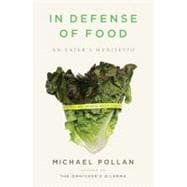
In Defense of Food : An Eater's Manifesto
by Pollan, MichaelEdition:
1st
ISBN13:
9781594201455
ISBN10:
1594201455
Format:
Hardcover
Pub. Date:
1/1/2008
Publisher(s):
Penguin Press HC, The
List Price: $21.95
Rent Textbook
(Recommended)Term
Due
Price
Short Term
Aug 2
$7.76
Semester
Oct 1
$10.98
Quarter
Aug 22
$9.88
$7.76
Buy Used Textbook
In Stock Usually Ships in 24 Hours.
$2.70
Buy New Textbook
In Stock Usually Ships in 24 Hours
$21.40
eTextbook
We're Sorry
Not Available
Questions About This Book?
Why should I rent this book?
Renting is easy, fast, and cheap! Renting from eCampus.com can save you hundreds of dollars compared to the cost of new or used books each semester. At the end of the semester, simply ship the book back to us with a free UPS shipping label! No need to worry about selling it back.
How do rental returns work?
Returning books is as easy as possible. As your rental due date approaches, we will email you several courtesy reminders. When you are ready to return, you can print a free UPS shipping label from our website at any time. Then, just return the book to your UPS driver or any staffed UPS location. You can even use the same box we shipped it in!
What version or edition is this?
This is the 1st edition with a publication date of 1/1/2008.
What is included with this book?
- The New copy of this book will include any supplemental materials advertised. Please check the title of the book to determine if it should include any CDs, lab manuals, study guides, etc.
- The Used copy of this book is not guaranteed to inclue any supplemental materials. Typically, only the book itself is included.
- The Rental copy of this book is not guaranteed to include any supplemental materials. You may receive a brand new copy, but typically, only the book itself.
Summary
What to eat, what not to eat, and how to think about health: a manifesto for our times "Eat food. Not too much. Mostly plants." These simple words go to the heart of Michael Pollan's In Defense of Food, the well-considered answers he provides to the questions posed in the bestselling The Omnivore's Dilemma. Humans used to know how to eat well, Pollan argues. But the balanced dietary lessons that were once passed down through generations have been confused, complicated, and distorted by food industry marketers, nutritional scientists, and journalists-all of whom have much to gain from our dietary confusion. As a result, we face today a complex culinary landscape dense with bad advice and foods that are not "real." These "edible foodlike substances" are often packaged with labels bearing health claims that are typically false or misleading. Indeed, real food is fast disappearing from the marketplace, to be replaced by "nutrients," and plain old eating by an obsession with nutrition that is, paradoxically, ruining our health, not to mention our meals. Michael Pollan's sensible and decidedly counterintuitive advice is: "Don't eat anything that your great-great grandmother would not recognize as food." Writing In Defense of Food, and affirming the joy of eating, Pollan suggests that if we would pay more for better, well-grown food, but buy less of it, we'll benefit ourselves, our communities, and the environment at large. Taking a clear-eyed look at what science does and does not know about the links between diet and health, he proposes a new way to think about the question of what to eat that is informed by ecology and tradition rather than by the prevailing nutrient-by-nutrient approach. In Defense of Foodreminds us that, despite the daunting dietary landscape Americans confront in the modern supermarket, the solutions to the current omnivore's dilemma can be found all around us. In looking toward traditional diets the world over, as well as the foods our families-and regions-historically enjoyed, we can recover a more balanced, reasonable, and pleasurable approach to food. Michael Pollan's bracing and eloquent manifesto shows us how we might start making thoughtful food choices that will enrich our lives and enlarge our sense of what it means to be healthy.
Author Biography
Michael Pollan is the author of four previous books, including The Omnivore's Dilemma and The Botany of Desire, both New York Times bestsellers. A longtime contributor to The New York Times, he is also the Knight Professor of journalism at Berkeley.
Table of Contents
| Introduction: An Eater's Manifesto | p. 1 |
| The Age of Nutritionism | p. 17 |
| From Foods to Nutrients | p. 19 |
| Nutritionism Defined | p. 27 |
| Nutritionism Comes to Market | p. 32 |
| Food Science's Golden Age | p. 36 |
| The Melting of the Lipid Hypothesis | p. 40 |
| Eat Right, Get Fatter | p. 50 |
| Beyond the Pleasure Principle | p. 53 |
| The Proof in the Low-Fat Pudding | p. 58 |
| Bad Science | p. 61 |
| Nutritionism's Children | p. 78 |
| The Western Diet and the Diseases of Civilization | p. 83 |
| The Aborigine in All of Us | p. 85 |
| The Elephant in the Room | p. 89 |
| The Industrialization of Eating: What We Do Know | p. 101 |
| From Whole Foods to Refined | p. 106 |
| From Complexity to Simplicity | p. 114 |
| From Quality to Quantity | p. 118 |
| From Leaves to Seeds | p. 124 |
| From Food Culture to Food Science | p. 132 |
| Getting Over Nutritionism | p. 137 |
| Escape from the Western Diet | p. 139 |
| Eat Food: Food Defined | p. 147 |
| Mostly Plants: What to Eat | p. 161 |
| Not Too Much: How to Eat | p. 182 |
| Acknowledgments | p. 202 |
| Sources | p. 206 |
| Resources | p. 229 |
| Index | p. 231 |
| Table of Contents provided by Blackwell. All Rights Reserved. |
CART


