
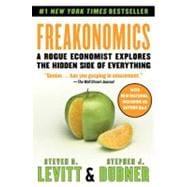
Freakonomics : A Rogue Economist Explores the Hidden Side of Everything
by Dubner, Stephen J.9780060731335
Rent Book
(Recommended)Buy Used Book
Buy New Book
eBook
We're Sorry
Not Available
Questions About This Book?
- The New copy of this book will include any supplemental materials advertised. Please check the title of the book to determine if it should include any CDs, lab manuals, study guides, etc.
- The Used copy of this book is not guaranteed to inclue any supplemental materials. Typically, only the book itself is included.
- The Rental copy of this book is not guaranteed to include any supplemental materials. You may receive a brand new copy, but typically, only the book itself.
Customer Reviews
by


Summary
Which is more dangerous, a gun or a swimming pool?
What do schoolteachers and sumo wrestlers have in common?
How much do parents really matter?
These may not sound like typical questions for an economist to ask. But Steven D. Levitt is not a typical economist. He studies the riddles of everyday life—from cheating and crime to parenting and sports—and reaches conclusions that turn conventional wisdom on its head. Freakonomics is a groundbreaking collaboration between Levitt and Stephen J. Dubner, an award-winning author and journalist. They set out to explore the inner workings of a crack gang, the truth about real estate agents, the secrets of the Ku Klux Klan, and much more. Through forceful storytelling and wry insight, they show that economics is, at root, the study of incentives—how people get what they want or need, especially when other people want or need the same thing.
"Freakonomics challenges conventional wisdom and makes for fun reading." - Book Sense Picks and Notables
"Freakonomics was the ‘It’ book of 2005." - Fort Worth Star-Telegram
"Hard to resist." - Publishers Weekly (starred review)
Author Biography
Table of Contents
| An Explanatory Note | p. xxiii |
| In which the origins of this book are clarified. | |
| Introduction: The Hidden Side of Everything | p. 1 |
| In which the book's central idea is set forth: namely, if morality represents how people would like the world to work, then economics shows how it actually does work. | |
| Why the conventional wisdom is so often wrong | |
| How "experts"-from crimnologists to real-estate agents to political scientists-bend the facts | |
| Why knowing what to measure, and how to measure it, is the key to understanding modern life | |
| What is "freakonomics," anyway? | |
| What Do Schoolteachers and Sumo Wrestlers Have in Common? | p. 15 |
| In which we explore the beauty of incentives, as well as their dark side-cheating. | |
| Who cheats? Just about everyone | |
| How cheaters, cheat, and how to catch them | |
| Stories from an Israeli day-care center | |
| The sudden disappearance of seven millon American childern | |
| Cheating schoolteachers in Chicago | |
| Why cheating to lose is worse than cheating to win | |
| Could sumo wrestling, the national sport of Japan, be corrupt? | |
| What the Bagel Man saw: mankind may be more honest than we think | |
| How Is the Ku Klux Klan Like A Group of Real-Estate Agents? | p. 51 |
| In which it is argued that nothing is more powerful than information, especially when its power is abused. | |
| Spilling the Ku Klux Klan's secrets | |
| Why experts of every kind are in the perfect position to exploit you | |
| The antidote to information abuse: the Internet | |
| Why a new car is suddenly sorth so much less the moment it leaves the lot | |
| Breaking the real-estate agent code: what "well maintained" really means | |
| Is Trent Lott more racist than the average Weakest Link contestant? | |
| What do online daters lie about? | |
| Why Do Drug Dealers Still Live with Their Moms? | p. 85 |
| In which the conventional wisdom is often found to be a web of fabrication, self-interest, and convenience. | |
| Why experts routinely make up statistics; the invention of chronic halitosis | |
| How to ask a good question | |
| Sudhir Venkatesh's long, strange trip into the crack den | |
| Why prostitutes earn more than architects | |
| What a drug dealer, a high-school quarterback, and an editorial assistant have in common | |
| How the invention of crack cocaine mirrored the invention of nylon stocking | |
| Was crack the worst thing to bit black Americans since Jim Crow? | |
| Where Have all the Criminals Gone? | p. 115 |
| In which the facts of crime are sorted out from the fictions. | |
| What Nicolae Ceauşescu learned-the hard way-about abortion | |
| Why the 1960s was a great time to be a criminal | |
| Think the roaring 1990s economy put a crimp on crime? think again | |
| Why capital punishment doesn't deter criminals | |
| Do police actually lower crime rates? | |
| Prisons, prisons everywhere | |
| Seeing through the New York City police "miracle" | |
| What is a gun, really? | |
| Why early crack dealers were like Microsoft millionaires and later crack dealers were like Pets.com | |
| The superpredator versus the senior citizen | |
| Jane Roe, crime stopper: how the legalization of abortion changed every-thing. | |
| What Makes A Perfect Parent? | p. 147 |
| In which we ask, from a variety of angels, a pressing question: do parents really matter? | p. 147 |
| The conversion of parenting from an art to a science | |
| Why parenting experts like to scare parents to death | |
| Which is more dangerous: a gun or a swimming pool? | |
| The economics of fear | |
| Obsessive parents and the nature-nurture quagmire | |
| Why a good school isn't as good as you might think | |
| The black-white test gap and "acting white" | |
| Eight things that make a child do better in school and eight that don't | |
| Perfect Parenting, Part II; or: Would a Roshanda By Any Other Name Smell As Sweet? | p. 181 |
| In which we weigh the importance of a parent's first official act-naming the baby. | |
| A boy named Winner and his brother, Loser | |
| The blackest names and the whitest names | |
| The segregation of culture: why Seinfeld never made the top fifty among black viewers | |
| If you have a really bad banem should you just change it? | |
| High-end names and low-end names (and how one becomes the other) | |
| Britney Spears: a symptom, not a cause | |
| Is Aviva the next Madison? | |
| What your parents were telling the world when they gave you your name. | |
| Epilogue: Two Paths to Harvard | p. 209 |
| In which the dependability of data meets the randomness of life. | |
| Bonus Matter | p. 213 |
| "The Probability That a Real-Estate Agent Is Cheating You..." | p. 215 |
| Selected "Freakonomics" Columns From The New York Times Magazine | p. 233 |
| A Q&A with the Authors | p. 261 |
| Notes | p. 269 |
| Acknowledgments | p. 295 |
| Index | p. 297 |
| Table of Contents provided by Ingram. All Rights Reserved. |
CART


