 Top
Top
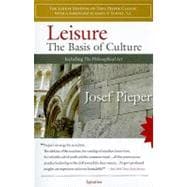
Note: Supplemental materials are not guaranteed with Rental or Used book purchases.
Purchase Benefits
 Free Shipping On Orders Over $35!
 Get Rewarded for Ordering Your Textbooks! Enroll Now
 We Buy This Book Back!
 Customer Reviews Read Reviews
 Write a Review
What is included with this book?
| Foreword | p. 9 |
| Author's Preface to the English Edition | p. 15 |
| Leisure The Basis Of Culture | |
| Leisure the foundation of Western culture | |
| "We are 'unleisurely' in order to have leisure" | |
| Aristotle | |
| The claims of the world of "total work" | p. 19 |
| "Intellectual work" and "intellectual worker" | |
| Discursive thought and "intellectual contemplation" | |
| Kant and the Romantics | |
| Ratio and Intellectus: the medieval conception of knowledge | |
| Contemplation "superhuman" | |
| Knowledge as "work": the two aspects of this conception | |
| "Unqualified activity" | |
| Effort and effortlessness | |
| Hard work is what is good | |
| Antisthenes | |
| Thomas Aquinas: "it is not the difficulty which is the decisive point" | |
| Contemplation and play | |
| Willingness to suffer | |
| First comes the "gift" | |
| "Intellectual work" as a social function | p. 25 |
| Sloth (acedia) and the incapacity to leisure | |
| Leisure as non-activity | |
| Leisure as a festive attitude | |
| Leisure and rest from work | |
| Leisure above all functions | |
| Leisure as a means of rising above the "really human" | p. 43 |
| The influence of the ideal of leisure- "Humanism" an inadequate position? | |
| Excursus on "proletariat" | |
| The philosopher and the common working man | |
| Man "fettered to work" | |
| Lack of property, State compulsion and inner impoverishment as the causes | |
| "Proletarians" not limited to the proletariat | |
| artes liberates and artes serviles | |
| Proudhon on Sunday | |
| "Deprole-tarianization" and the opening of the realm of leisure | p. 53 |
| Leisure made inwardly possible through Divine Worship | |
| Feast and worship | |
| Unused time and space | |
| The world of work and the Feast day | |
| Leisure divorced from worship becomes idleness | |
| The significance of Divine worship | p. 65 |
| The Philosophical Act | |
| By philosophizing we step beyond the world of work | |
| "Common need" and "common good" | |
| The "world of total work" rests on the identification of "common need" and "common good" | |
| The situation of philosophy in the "world of work" | |
| The relation between religious acts and aesthetic acts, between philosophizing and the experience of love or death | |
| Sham forms of these basic attitudes in life | |
| The everlasting misunderstanding between philosophy and the everyday world of work: The Thracian Maid and a figure in the Platonic dialogues (Appollodorus). The positive aspect of their incommensurability: the freedom of philosophy (its unusableness) | |
| The knowledge of the functionary and the knowledge of a gentleman | |
| The sciences "unfiree" | |
| Philosophy free, its theoretical character | |
| The presupposition of theoria | |
| The belief that man's real wealth consists neither in the satisfaction of his needs, nor in the control of nature | p. 77 |
| Where does the philosophical act carry us when it transcends the "world of work"? | |
| The world as a field of relations | |
| The hierarchie gradations of the world | |
| The notion "surroundings" (v. Uexküll) | |
| Spirit as the power of apprehending the world; spirit exists within the whole of reality | |
| Being as related to spirit: the truth of things | |
| The gradations of inwardness: the relation to the totality of being and personality | |
| The world of spirit: the totality of things and the essence of things | |
| Man not a pure spirit | |
| Man's field of relations: both world and environment, both together | |
| Philosophizing as a step beyond our environment vis-à-vis de Vunivers | |
| The step as "superhuman" | |
| The distinguishing mark, of a philosophical question: it is on the horizon of the whole of reality | p. 93 |
| "World" and "environment" are not watertight compartments | |
| The world preserved in the environment: wonder | |
| The "un-bourgeois" character of philosophical wonder | |
| The danger of being uprooted from the workaday world | |
| Wonder as "the confusion of thought at itself" | |
| The inner direction of wonder not aimed at doubt but at the sense of mystery | |
| Wonder as the moving principle of philosophy | |
| The structure of hope and the structure of wonder similar | |
| The special sciences cease "wondering", philosophy does not | |
| Philosophia as the loving search for wisdom as it is possessed by God | |
| The inner impossibility of a "closed" system of philosophy | |
| Philosophizing as the completion of man's existence | p. 109 |
| Philosophy always preceded by a traditional interpretation of the world | |
| Plato, Aristotle and the pre-socratics in their relation to tradition | |
| Plato tradition as revelation | |
| Its freedom vis-à-vis theology one of the^ marks of Plato's philosophizing | |
| Christian theology the form of pre-philosophic tradition to be found in the West | |
| The vitality of philosophy dependent upon its relation to theology | |
| Is a non-Christian philosophy possible? | |
| Christian philosophy not characterized by its ready answers but by its pro-founder apprehension of the mysterious nature of the world | |
| Christian philosophy not intellectually simpler | |
| The joy which goes with not being able to understand utterly and completely | |
| Christianity not, in the first place, doctrine but reality | |
| The real soil of Christian philosophizing | |
| the living experience of Christianity as reality | p. 127 |
| Table of Contents provided by Ingram. All Rights Reserved. |
The New copy of this book will include any supplemental materials advertised. Please check the title of the book to determine if it should include any access cards, study guides, lab manuals, CDs, etc.
The Used, Rental and eBook copies of this book are not guaranteed to include any supplemental materials. Typically, only the book itself is included. This is true even if the title states it includes any access cards, study guides, lab manuals, CDs, etc.


Need Help? Copyright © 1999-2024