
More New and Used
from Private Sellers
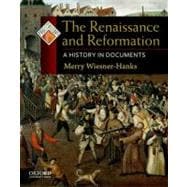
The Renaissance and Reformation A History in Documents
by Wiesner-Hanks, MerryISBN13:
9780195338027
ISBN10:
0195338022
Format:
Paperback
Pub. Date:
9/9/2011
Publisher(s):
Oxford University Press, USA
List Price: $34.95
Rent Textbook
(Recommended)Term
Due
Price
Short Term
Aug 2
$9.84
Semester
Dec 20
$13.98
Quarter
Sep 18
$12.23
$9.84
Buy Used Textbook
In Stock Usually Ships in 24 Hours.
$20.80
Buy New Textbook
Usually Ships in 3-5 Business Days
$34.08
eTextbook
We're Sorry
Not Available
Questions About This Book?
Why should I rent this book?
Renting is easy, fast, and cheap! Renting from eCampus.com can save you hundreds of dollars compared to the cost of new or used books each semester. At the end of the semester, simply ship the book back to us with a free UPS shipping label! No need to worry about selling it back.
How do rental returns work?
Returning books is as easy as possible. As your rental due date approaches, we will email you several courtesy reminders. When you are ready to return, you can print a free UPS shipping label from our website at any time. Then, just return the book to your UPS driver or any staffed UPS location. You can even use the same box we shipped it in!
What version or edition is this?
This is the edition with a publication date of 9/9/2011.
What is included with this book?
- The New copy of this book will include any supplemental materials advertised. Please check the title of the book to determine if it should include any CDs, lab manuals, study guides, etc.
- The Used copy of this book is not guaranteed to inclue any supplemental materials. Typically, only the book itself is included.
- The Rental copy of this book is not guaranteed to include any supplemental materials. You may receive a brand new copy, but typically, only the book itself.
Summary
At first glance, the Renaissance and the Reformation--two movements (one cultural, one religious) that defined Europe from 1400 to 1600--may appear to be polar opposites. The Renaissance found scholars and artists celebrating the beauty and splendor of the material world, while the Reformation saw Protestant and Catholic religious leaders and their followers focusing on eternal salvation. However, there were actually striking similarities between these two worlds. For instance, while both Renaissance artists and Reformation pastors originally desired a return to a "golden age" of the past, they both ended up creating something very new instead. InThe Renaissance and Reformation, Merry Wiesner-Hanks allows the historical participants to tell their own stories. She presents a mix of visual sources and written documents not only from learned scholars, trained artists, university-educated religious reformers, and powerful political leaders--but also from more ordinary men and women. Leonardo da Vinci considers the merits of painting versus poetry in his notebook, while the Italian diplomat Baldassar Castiglione recommends the pastime of music-making to gentlemen in his book The Courtier. A group of small-time investors signs a contract for a trading venture from Genoa to Corsica and Sardinia, and a wealthy Florentine widow writes a letter to her son, weighing his ability to start a new business. A picture essay uses individual and family portraits to discuss ideas about personality, temperament, and "genius"; social differences in marital patterns; and changes in family relationships. Wiesner-Hanks places events in Europe in a global context, allowing readers to examine the ways in which they were related to the voyages of exploration.
Author Biography
Merry Wiesner-Hanks is Distinguished Professor of History at the University of Wisconsin-Milwaukee. She is the editor of the Sixteenth Century Journal and the Journal of Global History, the author or editor of twenty books, including Women and Gender in Early Modern Europe (2008) and Early Modern Europe 1450-1789 (2006).
Table of Contents
What Is a Document?
How to Read a Document
Introduction: Re-births and Reformations
Note on Sources and Interpretation
Chapter 1: The Tumultuous Late Middle Ages
The Black Death
Reactions and Explanations
Religion and the Plague
Economic and Social Effects
War and Revolts
Chapter 2: The Past and the Perfect
Florence, A City of Gold
The Glories and Perils of Poetry
Fame and the Renaissance Man
Perfect Gentlemen, Perfect Ladies
A Perfect Prince or a Perfect Tyrant?
Chapter 3: The Glory of the World
The Book of Nature
Nature vs. Art
Painters, Poets, and Nature
The Artist as Poet
Fleeting Life, Fleeting Love
Music to Charm the Soul
Messages from the Stars
Chapter 4: Picture Essay: The Individual and the Family
Chapter 5: Merchants and Master Craftsmen
The Commercial Revolution
Families and Fortunes
Merchants and Morality
Jews in Renaissance Cities
Clothing and Capitalism
Craft Guilds
Chapter 6: Religious Reform and Renewal
Prayer, Pilgrimages, and Penance
The Power of the Pope
Calls for Reform
Reform Becomes Reformation
The Catholic Response
Chapter 7: Radical Hopes, Popular Protests, and Mystical Visions
Church and State
Martyrs and Enemies
The Peasants' War
A Mystic Reformer
Chapter 8: A New Moral Order
Calvin's Geneva
Marriage and the Reformation
Preaching and Teaching
Were the Reformers Successful?
Chapter 9: Global Connections and Challenges
Spices from the Indies
The Voyages of Columbus
The Impact of European Voyages in America and Africa
European Thinking about the Americas
Timeline
Further Reading
Websites
Text Credits
Picture Credits
Index
CART


