 Top
Top
Note: Supplemental materials are not guaranteed with Rental or Used book purchases.
Purchase Benefits
 Free Shipping On Orders Over $35!
 Get Rewarded for Ordering Your Textbooks! Enroll Now
 Customer Reviews Read Reviews
 Write a Review
What is included with this book?
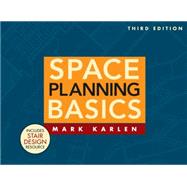
Mark Karlen, PhD, AIA, ASID, is the Director of the Master of Fine Arts in Interior Design program at Moore College of Art & Design, Philadelphia, Pennsylvania. He is an ASID/STEP Workshop Leader preparing interior designers for the National Council for Interior Design Qualification (NCIDQ) examination. In addition to many years spent in interior design education, he has extensive practice experience in architecture and interior design. The author's academic experience includes Head of the Interior Design Department at the University of Cincinnati, Chair at the Department of Interior Design at Pratt Institute, and Dean of the Art and Design Division at the Fashion Institute of Technology in New York.
| Preface: A Personal Introduction | |
| Introduction How to Read and Use This Book | |
| Chapter 1 | |
| Defining Terms and Intent | |
| The Synthesis Gap | |
| The Design Program | |
| Criteria Matrix | |
| Prototypical Plan Sketches | |
| Completing the Criteria Matrix | |
| Relationship Diagrams | |
| A Final Note on Planning Methodology | |
| Chapter 2 | |
| Bubble Diagramming | |
| Space Planning Exercises | |
| Block Planning | |
| Chapter 3 | |
| Human Factors | |
| Barrier-Free Design Standards | |
| The Three-Dimensional Reality | |
| Chapter 4 | |
| The Building Shell | |
| Plumbing Systems | |
| Heating, Ventilating, and Air Conditioning (HVAC) Systems | |
| Chapter 5 | |
| Building Codes | |
| Lighting Design | |
| Acoustical Planning | |
| Planning Rules of Thumb | |
| Flexibility/Multiuse | |
| Furniture | |
| Spatial Quality | |
| Interior Design Specialties | |
| Chapter 6 | |
| Getting Started | |
| Construction Reality | |
| Start with Plumbing | |
| Major Spaces Next | |
| Circulation Studies | |
| Basic Room Allocations | |
| Furniture and Equipment | |
| Storage and Filing | |
| Spatial Quality | |
| Review | |
| Revisions | |
| Chapter 7 | |
| Refining the Rough Plan | |
| The Preliminary Floor Plan | |
| Drawing Quality and Techniques | |
| Chapter 8 | |
| Basic Implications | |
| Programs Within Programs | |
| Open Plan/Systems Furniture | |
| The Speculative Office Building | |
| Future Expansion | |
| Planning New Buildings | |
| A Final Note | |
| Chapter 9 | |
| Chapter 10 | |
| Basic Implications | |
| Programs Within Programs | |
| Appendix: Design Programs and Building Shells | |
| Bibliography | |
| Index | |
| Table of Contents provided by Publisher. All Rights Reserved. |
The New copy of this book will include any supplemental materials advertised. Please check the title of the book to determine if it should include any access cards, study guides, lab manuals, CDs, etc.
The Used, Rental and eBook copies of this book are not guaranteed to include any supplemental materials. Typically, only the book itself is included. This is true even if the title states it includes any access cards, study guides, lab manuals, CDs, etc.


Need Help? Copyright © 1999-2024