
More New and Used
from Private Sellers
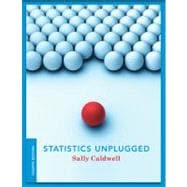
Statistics Unplugged
by Caldwell, SallyEdition:
4th
ISBN13:
9780840029430
ISBN10:
0840029438
Format:
Paperback
Pub. Date:
7/24/2012
Publisher(s):
Cengage Learning
List Price: $81.33
Rent Textbook
(Recommended)Term
Due
Price
Short Term
Aug 2
$25.66
Semester
Sep 30
$36.60
Quarter
Aug 21
$32.53
$25.66
Buy Used Textbook
In Stock Usually Ships in 24 Hours.
$56.93
Buy New Textbook
Currently Available, Usually Ships in 24-48 Hours
$79.30
eTextbook
180 day subscription
$47.99
Questions About This Book?
Why should I rent this book?
Renting is easy, fast, and cheap! Renting from eCampus.com can save you hundreds of dollars compared to the cost of new or used books each semester. At the end of the semester, simply ship the book back to us with a free UPS shipping label! No need to worry about selling it back.
How do rental returns work?
Returning books is as easy as possible. As your rental due date approaches, we will email you several courtesy reminders. When you are ready to return, you can print a free UPS shipping label from our website at any time. Then, just return the book to your UPS driver or any staffed UPS location. You can even use the same box we shipped it in!
What version or edition is this?
This is the 4th edition with a publication date of 7/24/2012.
What is included with this book?
- The New copy of this book will include any supplemental materials advertised. Please check the title of the book to determine if it should include any CDs, lab manuals, study guides, etc.
- The Used copy of this book is not guaranteed to inclue any supplemental materials. Typically, only the book itself is included.
- The Rental copy of this book is not guaranteed to include any supplemental materials. You may receive a brand new copy, but typically, only the book itself.
Summary
Learn statistics the easy way with STATISTICS UNPLUGGED! Written in a friendly, easy-to-understand style, this practical book takes the intimidation out of statistics and helps you understand the relevance of statistics to your own life. Interesting examples throughout the book allow you to see what is really going on with the numbers instead of being overwhelmed by the numbers themselves.
Table of Contents
| Introduction: Methods, Material, and Moments to Remember | p. 1 |
| The What and How of Statistics | p. 4 |
| Before We Begin | p. 5 |
| A World of Information | p. 5 |
| Levels of Measurement | p. 8 |
| Samples and Populations | p. 12 |
| The Purposes of Statistical Analysis | p. 14 |
| Descriptive Statistics | p. 15 |
| Inferential Statistics | p. 15 |
| Chapter Summary | p. 17 |
| Some Other Things You Should Know | p. 18 |
| Key Terms | p. 19 |
| Chapter Problems | p. 19 |
| Describing Data and Distributions | p. 21 |
| Before We Begin | p. 22 |
| Measures of Central Tendency | p. 22 |
| The Mean | p. 22 |
| The Median | p. 26 |
| The Mode | p. 28 |
| Measures of Variability or Dispersion | p. 30 |
| The Range | p. 30 |
| Deviations From the Mean | p. 31 |
| The Mean Deviation | p. 34 |
| The Variance | p. 36 |
| The Standard Deviation | p. 39 |
| n Versus n-1 | p. 46 |
| Chapter Summary | p. 50 |
| Some Other Things You Should Know | p. 50 |
| Key Terms | p. 51 |
| Chapter Problems | p. 51 |
| The Shape of Distributions | p. 54 |
| Before We Begin | p. 55 |
| The Basic Elements | p. 55 |
| Beyond the Basics: Comparisons and Conclusions | p. 58 |
| A Special Curve | p. 63 |
| Chapter Summary | p. 70 |
| Some Other Things You Should Know | p. 71 |
| Key Terms | p. 72 |
| Chapter Problems | p. 72 |
| The Normal Curve | p. 74 |
| Before We Begin | p. 75 |
| Real-World Normal Curves | p. 76 |
| Into the Theoretical World | p. 79 |
| The Table of Areas Under the Normal Curve | p. 82 |
| Finally, an Application | p. 89 |
| Chapter Summary | p. 93 |
| Some Other Things You Should Know | p. 94 |
| Key Terms | p. 94 |
| Chapter Problems | p. 95 |
| Four Fundamental Concepts | p. 96 |
| Before We Begin | p. 97 |
| Fundamental Concept #1: Random Sampling | p. 97 |
| Fundamental Concept #2: Sampling Error | p. 100 |
| Fundamental Concept #3: The Sampling Distribution of Sample Means | p. 103 |
| Fundamental Concept #4: The Central Limit Theorem | p. 105 |
| Chapter Summary | p. 110 |
| Some Other Things You Should Know | p. 111 |
| Key Terms | p. 112 |
| Chapter Problems | p. 112 |
| Confidence Intervals | p. 114 |
| Before We Begin | p. 115 |
| Confidence Interval for the Mean | p. 115 |
| Confidence Interval for the Mean With ¿ Known | p. 116 |
| An Application | p. 117 |
| Reviewing Z Values | p. 118 |
| Z Values and the Width of the Interval | p. 120 |
| Bringing in the Standard Error of the Mean | p. 120 |
| The Relevance of the Central Limit Theorem and the Standard Error | p. 123 |
| Confidence and Interval Width | p. 126 |
| A Brief Recap | p. 128 |
| Confidence Interval for the Mean With ¿ Unknown | p. 129 |
| Estimating the Standard Error of the Mean | p. 129 |
| The Family of t Distributions | p. 132 |
| The Table for the Family of t Distributions | p. 134 |
| An Application | p. 138 |
| A Final Comment About the Interpretation of a Confidence Interval for the Mean | p. 140 |
| A Final Comment About Z Versus t | p. 141 |
| Confidence Intervals for Proportions | p. 142 |
| An Application | p. 143 |
| Margin of Error | p. 145 |
| Chapter Summary | p. 147 |
| Some Other Things You Should Know | p. 149 |
| Key Terms | p. 150 |
| Chapter Problems | p. 150 |
| Hypothesis Testing With a Single Sample Mean | p. 155 |
| Before We Begin | p. 156 |
| Setting the Stage | p. 156 |
| A Hypothesis as a Statement of Your Expectations: The Case of the Null Hypothesis | p. 157 |
| Single Sample Test With ¿ Known | p. 159 |
| Refining the Null and Phrasing It the Right Way | p. 160 |
| The Logic of the Test | p. 161 |
| Applying the Test | p. 163 |
| Levels of Significance, Critical Values, and the Critical Region | p. 166 |
| But What If… | p. 170 |
| But What If We're Wrong? | p. 171 |
| Single Sample Test With ¿ Unknown | p. 176 |
| Applying the Test | p. 177 |
| Some Variations on a Theme | p. 178 |
| Chapter Summary | p. 179 |
| Some Other Things You Should Know | p. 180 |
| Key Terms | p. 181 |
| Chapter Problems | p. 181 |
| Hypothesis Testing With Two Samples (Mean Difference and Difference Between Means) | p. 185 |
| Before We Begin | p. 186 |
| Related Samples | p. 186 |
| The Logic of the Test | p. 187 |
| The Null Hypothesis | p. 191 |
| Combining the Logic and the Null | p. 191 |
| The Estimate of the Standard Error of the Mean Difference | p. 192 |
| Applying the Test | p. 193 |
| Interpreting the Results | p. 193 |
| Some Additional Examples | p. 194 |
| Independent Samples | p. 195 |
| The Logic of the Test | p. 196 |
| The Null Hypothesis | p. 199 |
| Combining the Logic and the Null | p. 199 |
| The Estimate of the Standard Error of the Difference of Means | p. 199 |
| Applying the Test | p. 202 |
| Interpreting the Results | p. 202 |
| Some Additional Examples | p. 203 |
| Chapter Summary | p. 204 |
| Some Other Things You Should Know | p. 205 |
| Key Terms | p. 206 |
| Chapter Problems | p. 206 |
| Beyond the Null Hypothesis | p. 210 |
| Before We Begin | p. 211 |
| Research or Alternative Hypotheses | p. 211 |
| One-Tailed and Two-Tailed Test Scenarios | p. 213 |
| Testing a Non-directional Research Hypothesis | p. 214 |
| Testing a Directional Research Hypothesis | p. 217 |
| Power and Effect | p. 221 |
| Chapter Summary | p. 225 |
| Some Other Things You Should Know | p. 226 |
| Key Terms | p. 226 |
| Chapter Problems | p. 227 |
| Analysis of Variance | p. 229 |
| Before We Begin | p. 231 |
| The Logic of ANOVA | p. 231 |
| From Curves to Data Distributions | p. 233 |
| The Different Means | p. 234 |
| From Different Means to Different Types of Variation | p. 236 |
| The Null Hypothesis | p. 238 |
| The Application | p. 239 |
| Calculating the Within-Groups Sum of Squares (SSW) | p. 240 |
| Calculating the Between-Groups Sum of Squares (SSB) | p. 243 |
| From Sums of Squares to Estimates of Variance | p. 245 |
| Calculating the F Ratio | p. 249 |
| The Interpretation | p. 250 |
| Interpretation of the F Ratio | p. 250 |
| Post Hoc Testing | p. 252 |
| Chapter Summary | p. 256 |
| Some Other Things You Should Know | p. 257 |
| Key Terms | p. 258 |
| Chapter Problems | p. 258 |
| The Chi-Square Test | p. 263 |
| Before We Begin | p. 264 |
| The Chi-Square Test of Independence | p. 264 |
| The Logic of the Test | p. 265 |
| A Focus on the Departure From Chance | p. 269 |
| The Null Hypothesis | p. 270 |
| The Application | p. 271 |
| The Formula | p. 275 |
| The Calculation | p. 275 |
| Conclusion and Interpretation | p. 276 |
| Chapter Summary | p. 278 |
| Some Other Things You Should Know | p. 279 |
| Key Terms | p. 279 |
| Chapter Problems | p. 280 |
| Correlation and Regression | p. 283 |
| Before We Begin | p. 284 |
| Scatter Plots | p. 284 |
| Linear Associations: Direction and Strength | p. 286 |
| Other Types of Association | p. 288 |
| Correlation Analysis | p. 289 |
| Two Variables: X and Y | p. 290 |
| The Logic of Correlation | p. 292 |
| The Formula for Pearson's r | p. 293 |
| Application | p. 296 |
| Interpretation | p. 298 |
| An Additional Step: Testing the Null | p. 300 |
| Conclusion and Interpretation | p. 301 |
| Regression Analysis | p. 302 |
| An Application | p. 302 |
| The Logic of Prediction and the Line of Best Fit | p. 304 |
| The Regression Equation | p. 306 |
| The Standard Error of the Estimate | p. 309 |
| Chapter Summary | p. 311 |
| Some Other Things You Should Know | p. 311 |
| Key Terms | p. 312 |
| Chapter Problems | p. 313 |
| Table of Areas Under the Normal Curve (Distribution of Z) | p. 318 |
| Family of t Distributions (Two-Tailed Test) | p. 320 |
| Family of t Distributions (One-Tailed Test) | p. 321 |
| Distribution of F (.05 Level of Significance) | p. 322 |
| Distribution of F (.01 Level of Significance) | p. 323 |
| Distribution of Q (.05 Level of Significance) | p. 324 |
| Distribution of Q (.01 Level of Significance) | p. 325 |
| Critical Values for Chi-Square (X2) | p. 326 |
| Critical Values of r (Correlation Coefficient) | p. 327 |
| Data Sets and Computer-Based Data Analysis | p. 328 |
| It Usually Starts with Rows and Columns | p. 328 |
| Good News; Words of Caution; It's Up to You | p. 332 |
| Some of the More Common Formulas Used in the Text | p. 334 |
| Answers to Chapter Problems | p. 337 |
| Glossary | p. 343 |
| References | p. 349 |
| Index | p. 351 |
| Table of Contents provided by Ingram. All Rights Reserved. |
CART


