
rent-now

Rent More, Save More! Use code: ECRENTAL

5% off 1 book, 7% off 2 books, 10% off 3+ books

9780071372268

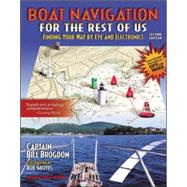
Boat Navigation for the Rest of Us: Finding Your Way By Eye and Electronics

by Brogdon, Bill
  • ISBN13:

    9780071372268

  • ISBN10:

    0071372261

  • Edition: 2nd
  • Format: Paperback
  • Copyright: 2001-02-20
  • Publisher: International Marine/Ragged Mountain Press
  • Purchase Benefits
  • Free Shipping Icon Free Shipping On Orders Over $35!
    Your order must be $35 or more to qualify for free economy shipping. Bulk sales, PO's, Marketplace items, eBooks and apparel do not qualify for this offer.
  • eCampus.com Logo Get Rewarded for Ordering Your Textbooks! Enroll Now
List Price: $30.00 Save up to $0.03
  • Buy New
    $29.97

    THIS IS A HARD-TO-FIND TITLE. WE ARE MAKING EVERY EFFORT TO OBTAIN THIS ITEM, BUT DO NOT GUARANTEE STOCK.

Summary

"Thorough treatment of traditional and electronic [sailing] methods by an expert."--WoodenBoatWant a full course in navigation? A whole toolbox of little-known tips and shortcuts to deal with real-life navigation situations without resorting to a slide rule? You get both inBoat Navigation for the Rest of Us, second edition, a guide to pleasureboat navigation that shows you how to combine electronic aids like radar and GPS with visual observations, simple chartwork, and common-sense piloting. In plain, simple language, it explains how to find where you are and get where you want to go with a minimum of fuss. You'll find many little-known, low-tech methods specifically designed for use aboard small powerboats and sailboats. This edition brings you up to speed on the many changes to navigation systems and equipment that have occurred over the past six years, including dramatic improvement in GPS accuracy, the proliferation of electronic charts and plotting systems, and the growing importance of the Internet as a navigation tool.

Author Biography

Captain Bill Brogdon served in the U.S. Coast Guard for 30 years. He writes regularly for major boating magazines and has twice received the Lawton Award for the most significant contribution to boating safety through the media.

Table of Contents

List of Sidebars

Acknowledgments

Introduction

1. How We Navigate

Going to an Object in Sight

Course, Speed, and Time: The DR

Finding the Boat's Position

Electronic Aid-to-Navigation Systems

Blending Visual, Instrument, and Electronic Information

2. Charts and Publications

Charts

Latitude and Longitude; Chart Scale and Projection; Chart Symbols; Direction and Distance; Depths; Chart Dates and Corrections; Great Lakes Charts; Charts for Rivers and Reservoirs

Publications

3. Navigation Instruments and Equipment

The Compass

Direction; Variation and Deviation; Bad Compass, Good Course

Depthfinders

Types of Depthfinders; Depth Corrections; Choosing a Depthfinder

Speed and Distance Logs

Time

Binoculars

A Navigator's Kit

Radar

Radar Measurements: Range and Bearing

4. Aid-to-Navigation Systems

Visual Aids to Navigation

Color, Shape, Lights, and Numbers; Intracoastal Waterway Aids to Navigation

Sound Signals

The Global Positioning System and Loran-C

Plotters; Additional Similarities and Differences; Accuracy; Coverage; Choosing an Electronic Navigation System; Choosing a Receiver; Differential GPS and WAAS

Radiobeacons and Radio Direction Finders

Racons

Other Radionavigation Systems

5. Finding Where You Are

Seaman's Eye

Radar and Seaman's Eye

Taking Departure

Ded (Dead) Reckoning

Time, Speed, and Distance Calculations

Time; Speed; Distance; Doing the Calculations Mentally; Direction and Time

Lines of Position and Fixes

Objects for Lines of Position; Fixes from Lines of Position; Radar Lines of Position; Line-of-Position and Fix Errors; Ranges

Estimated Positions

Distance Off

Electronic Navigation Systems

Waypoints

Measuring and Storing Waypoints with a Receiver; Plotting GPS and Loran-C Positions on a Chart; Position with Respect to Waypoints; Using Waypoints Measured by Another Receiver; Converting Waypoints from Loran-C to GPS; Corrections to Waypoint Positions

Avoiding GPS and Loran-C Errors

Check before Getting Underway; Electronic Position Jumps; Out of Tolerance Signals

6. Finding Where to Go

Seaman's Eye

Frozen Ranges; Steering Clear; Water Colors; Waves

Going to Distant Destinations

Electronic Navigation Systems

Coping with Current

Plotting; Calculating the Lead Angle; Shortcut Lead Angles; Practical Methods

Following the Desired Track Using a Navigation Receiver

Bearing to Waypoint; Cross-Track Error; Course Made Good; Estimated Time En Route; Scratch Waypoints; Staying in Good Water

Losing Electronic Navigation

Radar

Blending Electronic and Visual Navigation

Island Chains, Marshes, and Reservoirs

River Navigation

Night Navigation

Navigation in Fog

Radar for Collision Avoidance

Collision Avoidance in Poor Visibility

7. Special Techniques

Riding a Line of Position

The Deliberate Miss

The Electronic Navigation Hook

Look Behind You

Things That Go Wrong

Signs of Trouble; Data Entry Errors; Different Bearings to a Waypoint; Shifting Waypoints; Which One Is Wrong?; Onboard Interference; External Interference; Moving the Receiver Long Distances; Cross-Track Error Jumps to Zero

Appendix A. How GPS Works

Appendix B. How Loran-C Works

Appendix C. Good, Bad, and Ugly Receiver Features

Glossary

Index

Supplemental Materials

What is included with this book?

The New copy of this book will include any supplemental materials advertised. Please check the title of the book to determine if it should include any access cards, study guides, lab manuals, CDs, etc.

The Used, Rental and eBook copies of this book are not guaranteed to include any supplemental materials. Typically, only the book itself is included. This is true even if the title states it includes any access cards, study guides, lab manuals, CDs, etc.

Rewards Program