

rent-now

Rent More, Save More! Use code: ECRENTAL

5% off 1 book, 7% off 2 books, 10% off 3+ books

9780195331967

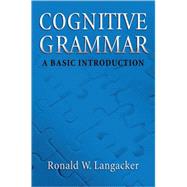
Cognitive Grammar A Basic Introduction

by Langacker, Ronald W.
  • ISBN13:

    9780195331967

  • ISBN10:

    0195331966

  • eBook ISBN(s):

    9780199887200

  • Format: Paperback
  • Copyright: 2008-02-04
  • Publisher: Oxford University Press

Note: Supplemental materials are not guaranteed with Rental or Used book purchases.

Purchase Benefits

  • Free Shipping Icon Free Shipping On Orders Over $35!
    Your order must be $35 or more to qualify for free economy shipping. Bulk sales, PO's, Marketplace items, eBooks and apparel do not qualify for this offer.
  • eCampus.com Logo Get Rewarded for Ordering Your Textbooks! Enroll Now
List Price: $83.20 Save up to $42.21
  • Rent Book $62.40
    Add to Cart Free Shipping Icon Free Shipping

    TERM
    PRICE
    DUE
    USUALLY SHIPS IN 3-5 BUSINESS DAYS
    *This item is part of an exclusive publisher rental program and requires an additional convenience fee. This fee will be reflected in the shopping cart.

How To: Textbook Rental

Looking to rent a book? Rent Cognitive Grammar A Basic Introduction [ISBN: 9780195331967] for the semester, quarter, and short term or search our site for other textbooks by Langacker, Ronald W.. Renting a textbook can save you up to 90% from the cost of buying.

Summary

This book fills a longstanding need for a basic introduction to CognitiveGrammar that is current, authoritative, comprehensive, and approachable. Itpresents a synthesis that draws together and refines the descriptive andtheoretical notions developed in this framework over the course of threedecades. In a unified manner, it accommodates both the conceptual and thesocial-interactive basis of linguistic structure, as well as the need for bothfunctional explanation and explicit structural description. Starting with thefundamentals, essential aspects of the theory are systematically laid out withconcrete illustrations and careful discussion of their rationale. Among thetopics surveyed are conceptual semantics, grammatical classes, grammaticalconstructions, the lexicon-grammar continuum characterized as assemblies ofsymbolic structures (form-meaning pairings), and the usage-based account ofproductivity, restrictions, and well-formedness. The theory's central claim -that grammar is inherently meaningful - is thereby shown to be viable. Theframework is further elucidated through application to nominal structure, clausestructure, and complex sentences. These are examined in broad perspective, withexemplification from English and numerous other languages. In line with thetheory's general principles, they are discussed not only in terms of theirstructural characterization, but also their conceptual value and functionalmotivation. Other matters explored include discourse, the temporal dimension oflanguage structure, and what grammar reveals about cognitive processes and theconstruction of our mental world.

Author Biography


Ronald W. Langacker retired after 37 years as Professor of Linguistics at the University of California, San Diego. He was originally trained in generative linguistics, and worked for a decade on the Uto-Aztecan family of Native American languages. Since 1976 he has been developing the theory of Cognitive Grammar (a radical alternative to generative theory) as part of the broader tradition of cognitive linguistics.

Table of Contents

Preliminaries
Orientationp. 3
Grammar and Lifep. 3
The Nature of the Beastp. 5
Grammar as Symbolizationp. 14
Conceptual Semanticsp. 27
Meaning and Semantic Representationsp. 27
Conceptual Contentp. 43
Construalp. 55
Specificityp. 55
Focusingp. 57
Prominencep. 66
Perspectivep. 73
Evidence for Semantic Claimsp. 85
Fundamentals
Grammatical Classesp. 93
Are Conceptual Characterizations Conceivable?p. 93
Nouns and Verbsp. 103
Classes of Relational Expressionsp. 112
Major Subclassesp. 128
Count and Mass Nounsp. 128
Perfective and Imperfective Verbsp. 147
Constructions: General Characterizationp. 161
Symbolic Assembliesp. 161
Constructional Schemasp. 167
Unipolar vs. Bipolar Organizationp. 174
Constructions: Descriptive Factorsp. 183
Correspondencesp. 183
Profile Determinancep. 192
Elaborationp. 198
Constituencyp. 205
Rules and Restrictionsp. 215
Networks and Schemasp. 215
Assessing Conventionalityp. 227
Networks of Constructionsp. 237
Regularityp. 244
Structures
Groundingp. 259
Subjective and Objective Construalp. 260
Type vs. Instancep. 264
Nominal Groundingp. 272
Clausal Groundingp. 296
Nominal Structurep. 310
Structure and Functionp. 310
Noun Modifiersp. 318
Classification and Quantificationp. 334
Inflection and Agreementp. 346
Clause Structurep. 354
Global Organizationp. 354
Subject and Objectp. 363
Clause Typesp. 382
Complex Verbsp. 400
Complex Sentencesp. 406
Ordination: Co- and Sub-p. 406
Clausal Connectionsp. 419
Finite Complementsp. 437
Frontiers
Discoursep. 457
The Basis of Language Structurep. 457
Conceptual Substratep. 463
Discourse Genresp. 477
Structure Buildingp. 486
Engaging the Worldp. 500
Dynamicityp. 500
Fictivityp. 524
Simulation and Subjectificationp. 535
Mind, Meaning, and Grammarp. 539
Referencesp. 541
Indexp. 551
Table of Contents provided by Ingram. All Rights Reserved.

Supplemental Materials

What is included with this book?

The New copy of this book will include any supplemental materials advertised. Please check the title of the book to determine if it should include any access cards, study guides, lab manuals, CDs, etc.

The Used, Rental and eBook copies of this book are not guaranteed to include any supplemental materials. Typically, only the book itself is included. This is true even if the title states it includes any access cards, study guides, lab manuals, CDs, etc.

Rewards Program