
rent-now

Rent More, Save More! Use code: ECRENTAL

5% off 1 book, 7% off 2 books, 10% off 3+ books

9780750657631

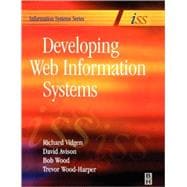
Developing Web Information Systems

by Vidgen; Avison; Wood; Wood-Harper
  • ISBN13:

    9780750657631

  • ISBN10:

    0750657634

  • eBook ISBN(s):

    9780750657631

  • Additional ISBN(s):

    9780080504186

  • Format: Paperback
  • Copyright: 10/23/2002
  • Publisher: Elsevier Science
  • Purchase Benefits
  • Free Shipping Icon Free Shipping On Orders Over $35!
    Your order must be $35 or more to qualify for free economy shipping. Bulk sales, PO's, Marketplace items, eBooks and apparel do not qualify for this offer.
  • eCampus.com Logo Get Rewarded for Ordering Your Textbooks! Enroll Now
List Price: $64.95
  • Digital
    $75.54*
    Add to Cart

    DURATION
    PRICE
    *To support the delivery of the digital material to you, a digital delivery fee of $3.99 will be charged on each digital item.

Summary

Developing Web Information Systems brings together traditional system development methods that have been taught for many years on information systems and computer science courses with web/e-commerce development. It is the first book to bring together IS development and the web applications in a thorough and systematic way. There is a running case study that illustrates web IS development from start to finish. The case is easy to understand (a theatre) and results in a working web application. Most, if not all, analysis and design texts fall short of making that step into software. The book draws heavily on practical experiences of web-based IS development resulting from commercial system development, so as well as appealing to students and academics, it will also interest practitioners. The coverage of data management and e-business strategy gives the book the broader scope essential for understanding IS development properly in an Internet context. * First book to bring together IS development and web applications thoroughly and systematically. * Covers full development process from strategy, through analysis and design, to working software. * Interactive case study which can be accessed on author's website.

Table of Contents

Preface xii
Information System Development
1(14)
Information systems and IT
1(2)
Information systems development methodologies
3(1)
Information systems development life-cycles
4(7)
Waterfall life-cycle
4(1)
Problems with the waterfall life-cycle
5(2)
Alternative life-cycles
7(1)
Evolutionary development
7(1)
Iterative (rapid) application development
7(2)
End-user development
9(1)
Prototyping
9(1)
Agile Development
9(2)
Alternative strategies for information systems acquisition
11(4)
Packaged solutions
11(1)
Outsourcing
11(1)
Application service providers
11(4)
Internet-based Information Systems
15(14)
The Internet
15(3)
A brief history
15(1)
From ARP Anet to the Internet
16(1)
Internet browser wars
16(1)
Internet statistics
17(1)
How the Internet works
18(5)
Internet protocols
18(1)
The worldwide web
19(2)
HyperText Markup Language (HTML)
21(1)
Web site authoring tools
22(1)
Beyond the basics
22(1)
Mobile Internet
23(1)
Open source software development
23(6)
The Linux phenomenon
24(1)
How OSS works
25(1)
Why OSS works
26(1)
Implications of OSS for IS development
26(3)
Web IS Development Methodology (WISDM)
29(12)
Introduction
29(1)
WISDM in context: the Multiview approach to IS development
29(3)
Using the Multiview framework to guide methodology generation
31(1)
The WISDOM matrix
32(2)
Organizational analysis
32(1)
Work design
33(1)
Information analysis
33(1)
Technical design
33(1)
Human computer interface design
33(1)
Moving around the methods matrix
33(1)
The role of the analyst: multiple perspectives
34(2)
WISDM and the IS development life-cycle
36(1)
Is web IS development different?
36(5)
e-Business Strategy
41(20)
Introduction
41(2)
Business models
43(1)
Business webs for the theatre industry
43(12)
Aggregation
46(3)
Agora
49(2)
Value chain
51(2)
Alliance
53(2)
Virtual communities
55(1)
Marketspace transformation and relationship capital
56(5)
Systems Thinking
61(18)
Introduction
61(1)
Difficulties and messes
61(2)
Themes in systems thinking
63(3)
Systems and patterns of organization
63(2)
Systems and emergent properties
65(1)
Recursion and system hierarchies
65(1)
Communication and control
65(1)
Thinking in loops
66(6)
Feedback loops
68(1)
Negative (or balancing) feedback
68(2)
Positive (or reinforcing) feedback
70(1)
Feedforward loops
70(2)
Patterns
72(4)
Limits to success
72(1)
Leverage points
73(1)
Fixes that fail
74(1)
Success to the successful
75(1)
Mental models
76(3)
Soft Systems Methodology
79(20)
Introduction
79(1)
Hard and soft systems thinking
80(2)
Organizations
80(1)
Hard and soft traditions
81(1)
Soft systems methodology
82(13)
Exploring the problem situation
83(1)
Situation considered problematic [1]
83(1)
Problem situation expressed [2]
84(2)
Below the line: root definitions and conceptual models
86(1)
Root definition of relevant systems [3]
86(4)
Conceptual models [4]
90(3)
Back above the line: taking action in the problem situation
93(1)
Comparison of models with real world [5]
94(1)
Evaluating change [6] and taking action [7]
94(1)
Beyond the basic form of SSM
95(4)
Using SSM to support IS Development
96(3)
Designing for User Satisfaction
99(24)
Introduction
99(2)
Sociotechnical design with ETHICS
101(8)
Participation
103(1)
Job satisfaction
103(2)
Sociotechnical systems design process
105(4)
The Scandinavian tradition of participative design
109(3)
Participative design principles
110(1)
The participative design process
111(1)
Web site quality -- the customer perspective
112(11)
Web site quality
112(1)
Usability
113(1)
Information quality
114(1)
Service interaction quality
114(1)
The application of WebQual to online bookstores
115(1)
Data collection
116(1)
The results
117(1)
Interpretation of the results
118(5)
Information Analysis
123(32)
Introduction
123(2)
The theatre booking system
124(1)
Information system modeling
125(1)
Analysis and design
125(1)
Structured systems analysis and design
126(1)
Object-oriented analysis and design
126(1)
The unified modeling language (UML)
126(4)
Fundamentals of object-orientation
127(1)
Objects
127(1)
Classes and instances
128(1)
Encapsulation and communication by messages
128(1)
Inheritance
129(1)
Polymorphism
129(1)
Requirements gathering and use case diagrams
130(4)
Requirements gathering
130(1)
Use case notation
131(2)
Extension, inclusion, and generalization
133(1)
Extends
133(1)
Include
133(1)
Generalization
133(1)
Describing a use case
134(1)
Class diagrams
134(11)
Relationships: associations
137(1)
Multiplicity
137(1)
Attributes and operations
138(1)
Attributes
138(1)
Operations
139(1)
Relationships: generalization
139(1)
Relationships: aggregation
140(1)
The theatre booking system class model
141(2)
Navigability
143(1)
Recursion
143(2)
Interaction diagrams
145(4)
Sequence diagram
146(2)
Collaboration diagram
148(1)
State transition diagrams
149(2)
Activity diagrams
151(4)
Technical Design
155(32)
Introduction
155(1)
Information system design
156(1)
System design overview
157(3)
Design constraints
159(1)
Logical database design
160(13)
Relational databases
160(1)
Primary keys
161(1)
Relationships
162(1)
Normalization
163(1)
Moving from UML class model to relational schema
164(1)
Implementing many-to-many relationships
165(1)
Implementing supertype and subtype classes
166(2)
Theatre booking system database design
168(1)
Entity-relationship model
168(1)
Entity and attribute list
169(3)
Object-oriented databases
172(1)
Object-relational hybrids
172(1)
Physical design
172(1)
Database transactions
172(1)
Application design
173(5)
Sequence diagrams
174(1)
User registration
175(1)
Payments
175(1)
Seat reservations -- locking strategy
176(1)
State transition diagrams
177(1)
User interface design
178(9)
Page layout guidelines
179(3)
Navigation schemes
182(1)
Frames
183(4)
Software System Construction
187(36)
Introduction
187(1)
Software implementation overview
188(1)
Business data implementation
189(8)
Defining tables
190(3)
Defining relationships
193(2)
Subtypes
195(1)
Populating the database
195(1)
SQL and queries
196(1)
Business logic
197(9)
Using ColdFusion to publish a database on the Internet
197(2)
Queries and the three ANSI three-level architecture model
199(1)
Developing Cold Fusion components for the business logic
200(4)
State management
204(1)
URL parameters and form fields
205(1)
Cookies
205(1)
Session variables
206(1)
Database transactions
206(1)
Presentation layer -- the user interface
206(4)
DreamWeaver Templates
207(1)
Style sheets
208(1)
Browser compatibility and bandwidth
209(1)
Putting it all together -- the complete application
210(5)
Wireless application protocol (WAP)
215(3)
Generating wireless content with ColdFusion
216(2)
Going live
218(5)
Get a domain name
218(1)
Hosting options
219(1)
Host the site at an Internet Service Provider (ISP)
219(1)
Co-host a server with an ISP
219(1)
Host your own server
220(1)
Promoting the site
220(1)
Monitoring the site
221(2)
Web Information Management
223(22)
Introduction
223(1)
eXtensible Markup Language (XML)
224(10)
XML data definitions
227(2)
Displaying XML in a browser
229(1)
Time to ditch HTML?
230(1)
Business applications of XML
231(1)
Intelligent searching
231(1)
Web automation for business to business transactions
231(1)
Intranet development and knowledge management
231(1)
Delivery to different platforms
231(1)
XML and databases, XML and Java
232(1)
XML, web services, and .NET
233(1)
Content management systems
234(11)
Issues in web content management
235(1)
Genesis of web content management systems
236(2)
A web content management systems framework
238(1)
Content life-cycle
238(1)
Organizational integration
238(1)
CMS process management
239(1)
CMS illustration: Intranet development
240(1)
The CMS framework as a diagnostic tool
241(4)
Reflections on WISDM
245(10)
Introduction
245(1)
The Global Drinks case
245(2)
The client organization in 1998
245(1)
The Global Drinks e-commerce project 1999--2001
246(1)
Outcomes of the intervention
246(1)
Web IS Development methods
247(3)
Organizational analysis
247(1)
Information analysis
248(1)
Work design
248(1)
Technical design
249(1)
Reflections on the case
250(1)
Methods and methodology in IS development
251(4)
Appendix A: Barchester Playhouse Case Study 255(8)
A1 Introduction
255(2)
A.1.1 The organization of the Playhouse
256(1)
A.2 Current box office operations
257(1)
A.2.1 Current IT systems
257(1)
Processes and data supported by the current box office system
258(1)
Issues with the current box office system
258(1)
A.3 Motivation for change
258(1)
A.3.1 Perceptions of the theatre
259(1)
A.4 Requirements of the theatre booking system
259(4)
Theatre layout
259(1)
Theatre productions and performances
260(1)
Ticket prices
260(1)
Ticket sales
261(1)
A.4.1 Roles and attitudes of those involved in the analysis
261(2)
Appendix B: Research Student Admissions Case Study 263(4)
B1 The current process
263(4)
Appendix C: Internet Resources 267(4)
C.1 WISDM
267(1)
C.2 Development tools
267(2)
Tools required for the TicketManager application
267(1)
Optional tools for the TicketManager application
268(1)
C.3 Web design
269(1)
C.4 Other useful sites
269(2)
Index 271

Supplemental Materials

What is included with this book?

The New copy of this book will include any supplemental materials advertised. Please check the title of the book to determine if it should include any access cards, study guides, lab manuals, CDs, etc.

The Used, Rental and eBook copies of this book are not guaranteed to include any supplemental materials. Typically, only the book itself is included. This is true even if the title states it includes any access cards, study guides, lab manuals, CDs, etc.

Rewards Program