
rent-now

Rent More, Save More! Use code: ECRENTAL

5% off 1 book, 7% off 2 books, 10% off 3+ books

9780310203919

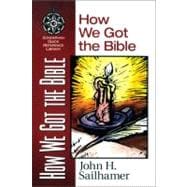
How We Got the Bible

by John H. Sailhamer
  • ISBN13:

    9780310203919

  • ISBN10:

    0310203910

  • Format: Paperback
  • Copyright: 1998-08-01
  • Publisher: Zondervan
  • Purchase Benefits
  • Free Shipping Icon Free Shipping On Orders Over $35!
    Your order must be $35 or more to qualify for free economy shipping. Bulk sales, PO's, Marketplace items, eBooks and apparel do not qualify for this offer.
  • eCampus.com Logo Get Rewarded for Ordering Your Textbooks! Enroll Now
List Price: $9.99 Save up to $0.01
  • Buy New
    $9.98

    THIS IS A HARD-TO-FIND TITLE. WE ARE MAKING EVERY EFFORT TO OBTAIN THIS ITEM, BUT DO NOT GUARANTEE STOCK.

Summary

When busy people want to know more about the Bible and the Christian faith, the Zondervan Quick-Reference Library offers an instant information alternative. Covering the basics of the faith and Bible knowledge in an easy-to-use format, this series helps new Christians and seasoned believers find answers to their questions about Christianity and the Bible. The information is presented in units of one or two pages, so that each section can be read in a few minutes. The Zondervan Quick-Reference Library makes important knowledge affordable, accessible, and easy to understand for busy people who don't have a lot of time to read or study.

Supplemental Materials

What is included with this book?

The New copy of this book will include any supplemental materials advertised. Please check the title of the book to determine if it should include any access cards, study guides, lab manuals, CDs, etc.

The Used, Rental and eBook copies of this book are not guaranteed to include any supplemental materials. Typically, only the book itself is included. This is true even if the title states it includes any access cards, study guides, lab manuals, CDs, etc.

Excerpts

Greek Writing
The New Testament is written in common Greek, called Koine.
Greek was the international language of the first century, spoken throughout
the ancient world as the language of business and commerce. The
Greek of the New Testament was also greatly influenced by the language
of the Greek translation of the Old Testament.
About two hundred years before the birth of Christ, the Hebrew Bible
was translated into Greek. This translation was called the Septuagint,
meaning “the Seventy.” It received that name from a popular story that this
was the work of seventy scholars from Palestine, commissioned by Egyptian
officials to translate the Old Testament for the famed library in Alexandria.
Though there may be some truth to the story, in all likelihood it arose
as an attempt to lend official recognition to the translation itself. To translate
the Word of God into a language other than Hebrew was still a new
concept in those days.
The translation was definitely the work of Greek-speaking Jews who
lived in Alexandria. They attempted to render the Hebrew text as literally
as possible, yet they also wanted it clearly understood in Greek. The
result was a Greek version of the Hebrew Bible whose language was
greatly influenced by Hebrew. That is the type of Greek we often find in
the New Testament. The same phenomenon can be seen in communities
that still rely on the King James Version. Often in their speech and prayers
one hears the familiar “thee” and “thou” of the King James Version.
The Greek of the New Testament is noted for its precision of expression
and wide range of vocabulary. Greek was especially adept at forming
compound words. When the apostle Paul, for example, wished to
express the unique origin of Scripture and its continued relevance in the
life of the Christian, he coined the term theopneustos, a word that literally
means “God(theos)-breathed(pneustos)” (2 Tim. 3:16). Though the
term had not been used before, it was clear to Greek readers what the
term meant: Scripture has a life-giving quality that comes only from God.
The New Testament authors used the full range of expression offered
them through the Greek language. The language of the Septuagint also
worked to their advantage, for many of the technical terms necessary for
the development of Christian theology (e.g., “redemption,” “righteousness”)
had already been developed in that translation. The noun “gospel”
and the verb “to evangelize” themselves were borrowed from the Greek
Old Testament.
The use of the Greek Old Testament in the New Testament also greatly helped the church to accommodate itself to the teaching of the Old Testament.
Written Records
Some of the data in the New Testament was in written form before
being used by the New Testament authors. In the prologue to his Gospel,
for example, Luke gives an account of how he came across the materials
he used: “Many have undertaken to draw up an account of the things that
have been fulfilled among us, just as they were handed down to us by those
who from the first were eyewitnesses. . . . Therefore, since I myself have
carefully investigated everything from the beginning, it seemed good also
to me to write an orderly account for you. . .” (Luke 1:1–3). Luke outlines
three stages: (1) the “eyewitness” accounts of the life and sayings
of Jesus; (2) those accounts “handed down to us” (middlemen, who wrote
down those accounts); and (3) the Gospel writers.
Luke is not clear how the first two stages occurred, but the study of
the Gospels suggests that these were written documents. Most New Testament
scholars believe an early collection of the sayings of Jesus circulated
widely before the Gospels were written, though no such document
exists today. It also seems apparent that Jesus himself never wrote anything,
nor do we find any indication that his disciples recorded his words
and deeds as they traveled. Nevertheless, from the fact that the words of
Jesus existed and that they were not contested by the early church, we do
know that someone somewhere had written down the events and teachings
of Jesus at an early stage.
In books other than the Gospels we find evidence of other types of
written records. There are, for example, early “confessions” or creeds of
the church. Paul mentions a tradition that he passed on to the Corinthi-ans:
“Christ died for our sins according to the Scriptures, . . . he was
buried,… he was raised on the third day according to the Scriptures”
(1 Cor. 15:3–4). Such creeds were probably the centerpiece of early Christian
worship. Songs sung in the early church were also an important written
source for the New Testament authors (cf. Col. 3:16). Songs are recognizable
by their poetic structure, some of which have been preserved
in the New Testament (e.g., the hymn about Christ’s humility in Phil. 2:6–
11). We also find summaries of early Christian teaching. Paul may have
drawn from such teaching when he enumerated the “fruit of the Spirit”
(Gal. 5:22–23). No doubt his letters contain segments of his own teaching
and preaching. Some New Testament writers even made use of other
New Testament books (cf. 2 Peter 3:15). There is compelling evidence that
both Matthew and Luke used Mark’s Gospel.
Book Making
The Egyptians had been making and importing a writing material
called papyrus for several thousand years. Papyrus, made of the papyrus
plant, was strong and durable and could be used to make scrolls up to
twenty-five feet. A papyrus document was often wrapped around a decorated
wooden staff, with the writing only on the inside. The scroll was held
with the right hand and rolled with the left hand. When not in use it was
kept rolled on the right side so that the beginning of the book was exposed.
The contents of the scroll were noted at the end where they were most
likely to be preserved.

Excerpted from How We Got the Bible by John H. Sailhamer
All rights reserved by the original copyright owners. Excerpts are provided for display purposes only and may not be reproduced, reprinted or distributed without the written permission of the publisher.

Rewards Program