

rent-now

Rent More, Save More! Use code: ECRENTAL

5% off 1 book, 7% off 2 books, 10% off 3+ books

9780060903251

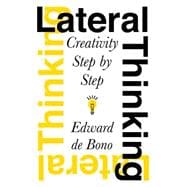
Lateral Thinking

by de Bono, Edward
  • ISBN13:

    9780060903251

  • ISBN10:

    0060903252

  • eBook ISBN(s):

    9780062043276

  • Edition: Revised
  • Format: Paperback
  • Copyright: 2009-12-07
  • Publisher: HarperCollins Publications

Note: Supplemental materials are not guaranteed with Rental or Used book purchases.

Purchase Benefits

  • Free Shipping Icon Free Shipping On Orders Over $35!
    Your order must be $35 or more to qualify for free economy shipping. Bulk sales, PO's, Marketplace items, eBooks and apparel do not qualify for this offer.
  • eCampus.com Logo Get Rewarded for Ordering Your Textbooks! Enroll Now
List Price: $16.99 Save up to $10.19
  • Rent Book
    $6.80
    Add to Cart Free Shipping Icon Free Shipping

    TERM
    PRICE
    DUE
    IN STOCK USUALLY SHIPS IN 24 HOURS.
    HURRY! ONLY 1 COPY IN STOCK AT THIS PRICE
    *This item is part of an exclusive publisher rental program and requires an additional convenience fee. This fee will be reflected in the shopping cart.

How To: Textbook Rental

Looking to rent a book? Rent Lateral Thinking [ISBN: 9780060903251] for the semester, quarter, and short term or search our site for other textbooks by de Bono, Edward. Renting a textbook can save you up to 90% from the cost of buying.

About This Book

Lateral Thinking: Creativity Step by Step

ISBN: 9780060903251

"Lateral Thinking: Creativity Step by Step" by Edward de Bono is a seminal book that introduced a new way of reasoning and decision-making. Published in 1973, this book has been a cornerstone in the field of creativity and problem-solving for decades. It's a must-read for anyone looking to enhance their creative thinking skills.

Who Uses It?

Primarily, this book is used by educators, students, and professionals seeking to improve their creative problem-solving abilities. It's also a valuable resource for anyone interested in understanding the principles of lateral thinking, including those in business, art, and other creative fields.

History and Editions

The first edition of "Lateral Thinking" was published in 1973, and since then, it has become a classic in the field of creativity. The book's practical approach to explaining how creativity works has made it a timeless resource. Dr. de Bono's techniques provide an alternative to just sitting around waiting for inspiration to strike, offering a structured method to tap into the potential of lateral thinking.

Author and Other Works

Edward de Bono is a renowned author and expert in the field of creativity and thinking. He has written numerous books on the subject, including "The Use of Lateral Thinking," "Teach Your Child to Think," and "Six Thinking Hats." Dr. de Bono's work focuses on enhancing cognitive abilities and promoting creative thinking.

Key Features

  • Practical Approach: The book provides a step-by-step guide to lateral thinking, making it accessible to readers of all levels.
  • Alternative Thinking: It introduces the concept of moving beyond vertical thinking to tap into the potential of lateral thinking.
  • Educational Value: The book is highly recommended for teachers and non-teachers alike, offering techniques that can be applied in various settings.

Detailed Information

ISBNs and Formats

  • Hardcover: ISBN-13: 9780060903251
  • eTextbook: ISBN-13: 9780062043276 (The ebook for "Lateral Thinking: Creativity Step by Step" is available right here on eCampus.com!)
  • eTextbook: ISBN-13: 9780062043276 (The ebook for "Lateral Thinking: Creativity Step by Step" is available right here on eCampus.com!)
  • Other Editions: The book has been re-released in various formats over the years, ensuring its continued relevance and availability.

Publication Details

  • Publisher: HarperCollins
  • Publication Date: February 24, 2015 (re-release)
  • Number of Pages: 304
  • Language: English
  • Dimensions: 5 x 8 inches
  • Weight: 8 ounces

Rental Options

Rental options are available through eCampus.com with various rental durations.

Related ISBNs

  • 9780062043276
  • 9780060903251

Note: The ISBNs listed are accurate and specific to the book "Lateral Thinking: Creativity Step by Step."

Table of Contents

Prefacep. 7
Introductionp. 9
Use of this bookp. 15
The way the mind worksp. 25
Difference between lateral and vertical thinkingp. 39
Attitudes towards lateral thinkingp. 47
Basic nature of lateral thinkingp. 51
The use of lateral thinkingp. 57
Techniquesp. 61
The generation of alternativesp. 63
Challenging assumptionsp. 91
Innovationp. 105
Suspended judgmentp. 107
Designp. 113
Dominant ideas and crucial factorsp. 123
Fractionationp. 131
The reversal methodp. 141
Brainstormingp. 149
Analogiesp. 167
Choice of entry point and attention areap. 175
Random stimulationp. 193
Concepts/divisions/polarizationp. 207
The new word pop. 225
Blocked by opennessp. 265
Description/problem solving/designp. 275
Summaryp. 297
Table of Contents provided by Ingram. All Rights Reserved.

Supplemental Materials

What is included with this book?

The New copy of this book will include any supplemental materials advertised. Please check the title of the book to determine if it should include any access cards, study guides, lab manuals, CDs, etc.

The Used, Rental and eBook copies of this book are not guaranteed to include any supplemental materials. Typically, only the book itself is included. This is true even if the title states it includes any access cards, study guides, lab manuals, CDs, etc.

Excerpts

Lateral Thinking
Creativity Step by Step

Chapter One

The way the mind works

The need for lateral thinking arises from the way the mind works. Though the information handling system called mind is highly effective it has certain characteristic limitations. These limitations are inseparable from the advantages of the system since both arise directly from the nature of the system. It would be impossible to have the advantages without the disadvantages. Lateral thinking is an attempt to compensate for these disadvantages while one still enjoys the advantages.

Code communication

Communication is the transfer of information. If you want someone to do something you could give him detailed instructions telling him exactly what to do. This would be accurate but it might take rather a long time. It would be much easier if you could simply say to him: `Go ahead and carry out plan number 4.' This simple sentence might replace pages of instruction. In the military world certain complex patterns of behaviour are coded in this manner so that one only has to specify the code number for the whole pattern of behaviour to be activated. It is the same with computers: much used programmes are stored under a particular heading and one can call them into use by just specifying that heading. When you go into a library to get a book you could describe in detail the book you wanted, giving author, title, subject, general outline etc. Instead of all that you could just give the code number from the catalogue.

Communication by code can only work if there are preset patterns. These patterns which may be very complex are worked out beforehand and are available under some code heading. Instead of transferring all the required information you just transfer the code heading. That code heading acts as a trigger word which identifies and calls up the pattern you want. This trigger word can be an actual code heading such as the name of a film or it can be some part of the information which acts to call up the rest. For instance one might not remember a film by its name but if one were to say: `Do you remember that film with Julie Andrews as a governess looking after some children in Austria?' the rest of the film might be easily brought to mind.

Language itself-is the most obvious code system with the words themselves as triggers. There are great advantages in any code system. It is easy to transfer a lot of information very quickly and without much effort. It makes it possible to react appropriately to a situation as soon as the situation is recognized from its code number without having to examine it in detail. It makes it possible to react appropriately to a situation before the situation has even developed fully-by identifying the situation from the initial aspects of it.

It is usual to think of communication as a two way affair: there is someone intending to send a message and someone trying to understand it. An arrangement of flags on a ship's mast is put there intentionally and anyone who understands the code can tell what it mean But a person who knows the code would also be able to pick out a message from a casual arrangement of flags used to decorate a party or a petrol station.

Communication can be a one way business. Dealing with the environment is an example of one way communication. One picks out messages from the environment even though no one has deliberately put them there.

If you offer a random arrangement of lines to a group of people they will soon start to pick out significant patterns. They will be convinced that the patterns have been put there deliberately or that the random arrangements are not random at all but actually constructed out of special patterns. Students who were asked to react in a certain way to a bell which was set off at random intervals soon became convinced that there was a meaningful pattern in the way the bell was sounded.

Communication by code or preset patterns requires the building up of a catalogue of patterns just as you can only use the catalogue number of a book in the library if someone has catalogued the books. As suggested above there does not have to be an actual code number for each pattern. Some part of the pattern itself may come to represent the whole pattern. If you recognized a man by hearing the name `John Smith' that would be using a code heading, but if you recognized him by the sound of his voice at a party that would be using part of the pattern. Opposite are shown two familiar patterns each of which is partly hidden behind some screen. One would have little difficulty in guessing the patterns from the parts that were accessible.

The mind as a patternmaking system

The mind is a patternmaking system. The information system of the mind acts to create patterns and to recognize them. This behaviour depends on the functional arrangement of the nerve cells of the brain. The effectiveness of the mind in its one way communication with the environment arises from this ability to create patterns, store them and recognize them. It is possible that a few patterns are built into the mind and these become manifest as instinctual behaviour but this seems relatively unimportant in man as compared to lower animals. The mind can also accept ready made patterns that are fed to it. But the most important property of the system is the ability to create its own patterns. The way the mind actually creates patterns is described elsewhere.Lateral Thinking
Creativity Step by Step
. Copyright © by Edward De Bono. Reprinted by permission of HarperCollins Publishers, Inc. All rights reserved. Available now wherever books are sold.


Excerpted from Lateral Thinking: Creativity Step by Step by Edward De Bono
All rights reserved by the original copyright owners. Excerpts are provided for display purposes only and may not be reproduced, reprinted or distributed without the written permission of the publisher.

Rewards Program