

rent-now

Rent More, Save More! Use code: ECRENTAL

5% off 1 book, 7% off 2 books, 10% off 3+ books

9780131543188

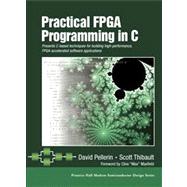
Practical FPGA Programming in C

by Pellerin, David; Thibault, Edward A., Ph.D.
  • ISBN13:

    9780131543188

  • ISBN10:

    0131543180

  • Edition: 1st
  • Format: Paperback
  • Copyright: 2005-04-22
  • Publisher: Prentice Hall

Note: Supplemental materials are not guaranteed with Rental or Used book purchases.

Purchase Benefits

  • Free Shipping Icon Free Shipping On Orders Over $35!
    Your order must be $35 or more to qualify for free economy shipping. Bulk sales, PO's, Marketplace items, eBooks and apparel do not qualify for this offer.
  • eCampus.com Logo Get Rewarded for Ordering Your Textbooks! Enroll Now
List Price: $84.99 Save up to $21.25
  • Rent Book $63.74
    Add to Cart Free Shipping Icon Free Shipping

    TERM
    PRICE
    DUE
    USUALLY SHIPS IN 2-3 BUSINESS DAYS
    *This item is part of an exclusive publisher rental program and requires an additional convenience fee. This fee will be reflected in the shopping cart.

How To: Textbook Rental

Looking to rent a book? Rent Practical FPGA Programming in C [ISBN: 9780131543188] for the semester, quarter, and short term or search our site for other textbooks by Pellerin, David; Thibault, Edward A., Ph.D.. Renting a textbook can save you up to 90% from the cost of buying.

Summary

FPGA brings high performance applications to market quickly - this book covers the many emerging platforms in a proven, effective manner.

Author Biography

Author Bio

David Pellerin is president and founder of Impulse Accelerated Technologies, a firm that serves systems designers who want to use FPGAs for hardware-based software acceleration and fast prototyping of mixed hardware/software systems. His Prentice Hall PTR books include VHDL Made Easy, Practical Design Using Programmable Logic, Digital Design Using ABEL, and Electronic Design Automation for Windows. Scott Thibault is president and founder of Green Mountain Computing Systems, developers of custom and OEM software that leverages advanced HDL and C-to-RTL expertise to improve time-to-market. Dr. Thibault holds a Ph.D. in computer science from the University of Rennes.


© Copyright Pearson Education. All rights reserved.

Table of Contents

Foreword by Clive "Max" Maxfield xiii
Why is this book of interest to the hardware folks?
xiii
And what about the software guys and gals?
xv
So what's the catch?
xvi
Preface xvii
C Language for FPGA-Based Hardware Design?
xviii
Compelling Platforms for Software Acceleration
xix
The Power to Experiment
xxi
How This Book Is Organized
xxi
Where This Book Came From
xxii
Acknowledgments xxiii
CHAPTER 1 The FPGA as a Computing Platform 1(16)
1.1 A Quick Introduction to FPGAs
2(2)
1.2 FPGA-Based Programmable Hardware Platforms
4(2)
1.3 Increasing Performance While Lowering Costs
6(2)
1.4 The Role of Tools
8(2)
1.5 The FPGA as an Embedded Software Platform
10(2)
1.6 The Importance of a Programming Abstraction
12(1)
1.7 When Is C Language Appropriate for FPGA Design?
13(2)
1.8 How to Use This Book
15(2)
CHAPTER 2 A Brief History of Programmable Platforms 17(14)
2.1 The Origins of Programmable Logic
18(5)
2.2 Reprogrammability, HDLs, and the Rise of the FPGA
23(2)
2.3 Systems on a Programmable Chip
25(2)
2.4 FPGAs for Parallel Computing
27(2)
2.5 Summary
29(2)
CHAPTER 3 A Programming Model for FPGA-Based Applications 31(14)
3.1 Parallel Processing Models
32(3)
3.2 FPGAs as Parallel Computing Machines
35(3)
3.3 Programming for Parallelism
38(1)
3.4 Communicating Process Programming Models
39(2)
3.5 The Impulse C Programming Model
41(2)
3.6 Summary
43(2)
CHAPTER 4 An Introduction to Impulse C 45(42)
4.1 The Motivation Behind Impulse C
47(1)
4.2 The Impulse C Programming Model
48(2)
4.3 A Minimal Impulse C Program
50(8)
4.4 Processes, Streams, Signals, and Memory
58(1)
4.5 Impulse C Signed and Unsigned Datatypes
59(1)
4.6 Understanding Processes
59(4)
4.7 Understanding Streams
63(3)
4.8 Using Output Streams
66(1)
4.9 Using Input Streams
67(2)
4.10 Avoiding Stream Deadlocks
69(4)
4.11 Creating and Using Signals
73(1)
4.12 Understanding Registers
74(2)
4.13 Using Shared Memories
76(5)
4.14 Memory and Stream Performance Considerations
81(5)
4.15 Summary
86(1)
CHAPTER 5 Describing a FIR Filter 87(16)
5.1 Design Overview
87(1)
5.2 The FIR Filter Hardware Process
88(2)
5.3 The Software Test Bench
90(7)
5.4 Desktop Simulation
97(1)
5.5 Application Monitoring
98(2)
5.6 Summary
100(3)
CHAPTER 6 Generating FPGA Hardware 103(30)
6.1 The Hardware Generation Flow
104(4)
6.2 Understanding the Generated Structure
108(4)
6.3 Stream and Signal Interfaces
112(4)
6.4 Using HDL Simulation to Understand Stream Protocols
116(3)
6.5 Debugging the Generated Hardware
119(6)
6.6 Hardware Generation Notes
125(2)
6.7 Making Efficient Use of the Optimizers
127(2)
6.8 Language Constraints for Hardware Processes
129(2)
6.9 Summary
131(2)
CHAPTER 7 Increasing Statement-Level Parallelism 133(14)
7.1 A Model of FPGA Computation
133(2)
7.2 C Language Semantics and Parallelism
135(1)
7.3 Exploiting Instruction-Level Parallelism
135(4)
7.4 Limiting Instruction Stages
139(2)
7.5 Unrolling Loops
141(1)
7.6 Pipelining Explained
142(3)
7.7 Summary
145(2)
CHAPTER 8 Porting a Legacy Application to Impulse C 147(16)
8.1 The Triple-DES Algorithm
148(2)
8.2 Converting the Algorithm to a Streaming Model
150(5)
8.3 Performing Software Simulation
155(1)
8.4 Compiling to Hardware
156(3)
8.5 Preliminary Hardware Analysis
159(1)
8.6 Summary
160(3)
CHAPTER 9 Creating an Embedded Test Bench 163(32)
9.1 A Mixed Hardware and Software Approach
164(1)
9.2 The Embedded Processor as a Test Generator
165(3)
9.3 The Role of Hardware Simulators
168(1)
9.4 Testing the Triple-DES Algorithm in Hardware
168(6)
9.5 Software Stream Macro Interfaces
174(1)
9.6 Building the Test System
175(19)
9.7 Summary
194(1)
CHAPTER 10 Optimizing C for FPGA Performance 195(14)
10.1 Rethinking an Algorithm for Performance
196(3)
10.2 Refinement 1: Reducing Size by Introducing a Loop
199(1)
10.3 Refinement 2: Array Splitting
199(2)
10.4 Refinement 3: Improving Streaming Performance
201(2)
10.5 Refinement 4: Loop Unrolling
203(1)
10.6 Refinement 5: Pipelining the Main Loop
204(4)
10.7 Summary
208(1)
CHAPTER 11 Describing System-Level Parallelism 209(48)
11.1 Design Overview
210(3)
11.2 Performing Desktop Simulation
213(1)
11.3 Refinement 1: Creating Parallel 8-Bit Filters
214(5)
11.4 Refinement 2: Creating a System-Level Pipeline
219(12)
11.5 Moving the Application to Hardware
231(25)
11.6 Summary
256(1)
CHAPTER 12 Combining Impulse C with an Embedded Operating System 257(22)
12.1 The uClinux Operating System
257(2)
12.2 A uClinux Demonstration Project
259(18)
12.3 Summary
277(2)
CHAPTER 13 Mandelbrot Image Generation 279(22)
13.1 Design Overview
280(2)
13.2 Expressing the Algorithm in C
282(3)
13.3 Creating a Fixed-Point Equivalent
285(1)
13.4 Creating a Streaming Version
286(4)
13.5 Parallelizing the Algorithm
290(7)
13.6 Future Refinements
297(2)
13.7 Summary
299(2)
CHAPTER 14 The Future of FPGA Computing 301(8)
14.1 The FPGA as a High-Performance Computer
302(3)
14.2 The Future of FPGA Computing
305(2)
14.3 Summary
307(2)
APPENDIX A Getting the Most Out of Embedded FPGA Processors 309(16)
A.1 FPGA Embedded Processor Overview
310(2)
A.2 Peripherals and Memory Controllers
312(1)
A.3 Increasing Processor Performance
313(1)
A.4 Optimization Techniques That Are Not FPGA-Specific
314(5)
A.5 FPGA-Specific Optimization Techniques
319(3)
A.6 Summary
322(3)
APPENDIX B Creating a Custom Stream Interface 325(16)
B.1 Application Overview
326(1)
B.2 The DS92LV16 Serial Link for Data Streaming
327(2)
B.3 Stream Interface State Machine Description
329(2)
B.4 Data Transmission
331(1)
B.5 Summary
332(9)
APPENDIX C Impulse C Function Reference 341(34)
APPENDIX D Triple-DES Source Listings 375(30)
APPENDIX E Image Filter Listings 405(12)
APPENDIX F Selected References 417(2)
Index 419

Supplemental Materials

What is included with this book?

The New copy of this book will include any supplemental materials advertised. Please check the title of the book to determine if it should include any access cards, study guides, lab manuals, CDs, etc.

The Used, Rental and eBook copies of this book are not guaranteed to include any supplemental materials. Typically, only the book itself is included. This is true even if the title states it includes any access cards, study guides, lab manuals, CDs, etc.

Excerpts

Preface Preface This is a book about software programming for FPGAs. To be more specific, this book is about using parallel programming techniques in combination with the C language to create FPGA-accelerated software applications. We have written this book to help bridge the gap--the great chasm, in fact--that exists between software development methods and philosophies, and the methods and philosophies of FPGA-based digital design. We understand that as a result we may be writing for two quite different audiences: software application developers and digital hardware designers. For software engineers, our goal is to present FPGAs as software-programmable computing resources. We hope to show that these devices, when programmed using appropriate methods, are not so different from other non-traditional computing platforms, such as DSPs. We will show, through example, that software development methods and software languages can be used in a practical way to create FPGA-based, high-performance computing applications, without a deep knowledge of hardware design. For hardware designers our intent is similar, but with a caveat: we are not trying to replace your existing methods of design or suggest that the methods and tools described in this book represent a "next wave" of hardware engineering. After all, if you are an FPGA designer using VHDL or Verilog to create complex electronic systems, the title of this book,Practical FPGA Programming in C, may sound like an oxymoron. How can C, a software programming language, be a practical way to describe digital electronic hardware? The truth is, sometimes the explicit and precise descriptions offered by hardware description languages (HDLs) are essential to achieve designs goals. But, as you'll see, this explicit control over hardware is not always necessary. In the same way that you might first write software in C and then recode key portions in assembler, hardware designers can benefit from tools that allow them to mix high-level and low-level descriptions as needed to meet design goals as quickly as possible. Even when the entire hardware design will be eventually be recoded with a lower-level HDL, high-level design languages allow hardware engineers to rapidly explore the design space and create working prototypes. So for you, the experienced hardware engineer, we'll state right up front that we agree with you. We do not believe that C and C++ (as used by legions of programmers worldwide) are practical replacements for VHDL, Verilog, or any other HDL. And we agree with you that C and C++ may not play a leading, or perhaps even significant, role as a design entry language for general-purpose ASIC and FPGA design, at least not as we know such design today. Nevertheless, we believe there is a place for C-based design in a hardware design flow. Still not convinced? Stay with us for a moment, and we'll explain. C Language for FPGA-Based Hardware Design? Let's think a bit more about the role of C--or lack of a role, as the case may be--in hardware design. Why is standard C not appropriate as a replacement for existing hardware design languages? Because any good programming language provides one important thing: a useful abstraction of its target. VHDL and Verilog (or, more precisely, the synthesizable subsets of these languages) succeed very well because they provide a rational, efficient abstraction of a certain class of hardware: level- and edge-sensitive registers with reset and clock logic, arbitrary logic gates, and somewhat larger clocked logic elements arranged in a highly parallel manner. All of today's FPGAs fit this pattern, and it is the pattern also found in the vast majority of today's ASIC designs, no matter how complex. The standard C language does not provide that level of abstract

Rewards Program