
rent-now

Rent More, Save More! Use code: ECRENTAL

5% off 1 book, 7% off 2 books, 10% off 3+ books

9780470022986

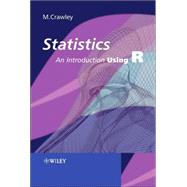
Statistics : An Introduction Using R

by Crawley, Michael J.
  • ISBN13:

    9780470022986

  • ISBN10:

    0470022981

  • Edition: 1st
  • Format: Paperback
  • Copyright: 2005-04-22
  • Publisher: WILEY
  • View Upgraded Edition
  • Purchase Benefits
  • Free Shipping Icon Free Shipping On Orders Over $35!
    Your order must be $35 or more to qualify for free economy shipping. Bulk sales, PO's, Marketplace items, eBooks and apparel do not qualify for this offer.
  • eCampus.com Logo Get Rewarded for Ordering Your Textbooks! Enroll Now
List Price: $52.00

Summary

Computer software is an essential tool for many statistical modelling and data analysis techniques, aiding in the implementation of large data sets in order to obtain useful results. R is one of the most powerful and flexible statistical software packages available, and enables the user to apply a wide variety of statistical methods ranging from simple regression to generalized linear modelling. Statistics: An Introduction using R is a clear and concise introductory textbook to statistical analysis using this powerful and free software, and follows on from the success of the author's previous best-selling title Statistical Computing. * Features step-by-step instructions that assume no mathematics, statistics or programming background, helping the non-statistician to fully understand the methodology. * Uses a series of realistic examples, developing step-wise from the simplest cases, with the emphasis on checking the assumptions (e.g. constancy of variance and normality of errors) and the adequacy of the model chosen to fit the data. * The emphasis throughout is on estimation of effect sizes and confidence intervals, rather than on hypothesis testing. * Covers the full range of statistical techniques likely to be need to analyse the data from research projects, including elementary material like t-tests and chi-squared tests, intermediate methods like regression and analysis of variance, and more advanced techniques like generalized linear modelling. * Includes numerous worked examples and exercises within each chapter. * Accompanied by a website featuring worked examples, data sets, exercises and solutions: http://www.imperial.ac.uk/bio/research/crawley/statistics Statistics: An Introduction using R is the first text to offer such a concise introduction to a broad array of statistical methods, at a level that is elementary enough to appeal to a broad range of disciplines. It is primarily aimed at undergraduate students in medicine, engineering, economics and biology - but will also appeal to postgraduates who have not previously covered this area, or wish to switch to using R.

Table of Contents

Preface xi
Chapter 1 Fundamentals 1(14)
Everything Varies
2(1)
Significance
3(1)
Good and Bad Hypotheses
3(1)
Null Hypotheses
3(1)
p Values
3(1)
Interpretation
4(1)
Statistical Modelling
4(1)
Maximum Likelihood
5(2)
Experimental Design
7(1)
The Principle of Parsimony (Occam's Razor)
7(1)
Observation, Theory and Experiment
8(1)
Controls
8(1)
Replication: It's the n's that Justify the Means
8(1)
How Many Replicates?
9(1)
Power
9(1)
Randomization
10(2)
Strong Inference
12(1)
Weak Inference
12(1)
How Long to Go On?
13(1)
Pseudoreplication
13(1)
Initial Conditions
14(1)
Orthogonal Designs and Non-orthogonal Observational Data
14(1)
Chapter 2 Dataframes 15(8)
Selecting Parts of a Dataframe: Subscripts
19(1)
Sorting
20(2)
Saving Your Work
22(1)
Tidying Up
22(1)
Chapter 3 Central Tendency 23(10)
Getting Help in R
31(2)
Chapter 4 Variance 33(18)
Degrees of Freedom
36(1)
Variance
37(2)
A Worked Example
39(3)
Variance and Sample Size
42(1)
Using Variance
43(1)
A Measure of Unreliability
44(1)
Confidence Intervals
45(1)
Bootstrap
46(5)
Chapter 5 Single Samples 51(22)
Data Summary in the One Sample Case
51(4)
The Normal Distribution
55(5)
Calculations using z of the Normal Distribution
60(4)
Plots for Testing Normality of Single Samples
64(1)
Inference in the One-sample Case
65(1)
Bootstrap in Hypothesis Testing with Single Samples
66(1)
Student's t-distribution
67(2)
Higher-order Moments of a Distribution
69(1)
Skew
69(2)
Kurtosis
71(2)
Chapter 6 Two Samples 73(30)
Comparing Two Variances
73(2)
Comparing Two Means
75(1)
Student's t-test
76(3)
Wilcoxon Rank Sum Test
79(2)
Tests on Paired Samples
81(2)
The Sign Test
83(1)
Binomial Tests to Compare Two Proportions
84(1)
Chi-square Contingency Tables
85(5)
Fisher's Exact Test
90(3)
Correlation and Covariance
93(2)
Data Dredging
95(1)
Partial Correlation
96(1)
Correlation and the Variance of Differences Between Variables
97(1)
Scale-dependent Correlations
98(2)
Kolmogorov-Smirnov Test
100(3)
Chapter 7 Statistical Modelling 103(22)
The Steps Involved in Model Simplification
105(1)
Caveats
106(1)
Order of Deletion
106(1)
Model Formulae in R
106(2)
Interactions Between Explanatory Variables
108(1)
Multiple Error Terms
109(1)
The Intercept as Parameter 1
109(1)
Update in Model Simplification
110(1)
Examples of R Model Formulae
110(1)
Model Formulae for Regression
111(2)
GLMs: Generalized Linear Models
113(1)
The Error Structure
114(1)
The Linear Predictor
115(1)
Fitted Values
116(1)
The Link Function
116(1)
Canonical Link Functions
117(1)
Proportion Data and Binomial Errors
117(1)
Count Data and Poisson Errors
118(1)
GAMs: Generalized Additive Models
119(1)
Model Criticism
119(1)
Summary of Statistical Models in R
120(1)
Model Checking
121(1)
Non-constant Variance: Heteroscedasticity
122(1)
Non-Normality of Errors
122(1)
Influence
123(1)
Leverage
123(1)
Mis-specified Model
124(1)
Chapter 8 Regression 125(30)
Linear Regression
128(1)
Linear Regression in R
129(7)
Error Variance in Regression: SSY = SSR + SSE
136(6)
Measuring the Degree of Fit, r²
142(1)
Model Checking
143(2)
Polynomial Regression
145(4)
Non-linear Regression
149(3)
Testing for Humped Relationships
152(1)
Generalized Additive Models (gams)
152(3)
Chapter 9 Analysis of Variance 155(32)
One-way Anova
155(6)
Shortcut Formula
161(2)
Effect Sizes
163(4)
Plots for Interpreting One-way Anova
167(4)
Factorial Experiments
171(4)
Pseudoreplication: Nested Designs and Split Plots
175(1)
Split-plot Experiments
176(2)
Random Effects and Nested Designs
178(1)
Fixed or Random Effects?
179(1)
Removing the Pseudoreplication
180(1)
Analysis of Longitudinal Data
180(1)
Derived Variable Analysis
181(1)
Variance Components Analysis (VCA)
181(4)
What is the Difference Between Split-plot and Hierarchical Samples?
185(2)
Chapter 10 Analysis of Covariance 187(8)
Chapter 11 Multiple Regression 195(14)
A Simple Example
195(7)
A More Complex Example
202(6)
Automating the Process of Model Simplification Using step
208(1)
AIC (Akaike's Information Criterion)
208(1)
Chapter 12 Contrasts 209(18)
Contrast Coefficients
210(1)
An Example of Contrasts in R
211(1)
A Priori Contrasts
212(2)
Model Simplification by Step-wise Deletion
214(3)
Contrast Sums of Squares by Hand
217(1)
Comparison of the Three Kinds of Contrasts
218(4)
Aliasing
222(1)
Contrasts and the Parameters of Ancova Models
223(3)
Multiple Comparisons
226(1)
Chapter 13 Count Data 227(20)
A Regression with Poisson Errors
227(2)
Analysis of Deviance with Count Data
229(5)
The Danger of Contingency Tables
234(3)
Analysis of Covariance with Count Data
237(3)
Frequency Distributions
240(7)
Chapter 14 Proportion Data 247(16)
Analyses of Data on One and Two Proportions
249(1)
Count Data on Proportions
249(1)
Odds
250(1)
Overdispersion and Hypothesis Testing
251(2)
Applications
253(1)
Logistic Regression with Binomial Errors
253(2)
Proportion Data with Categorical Explanatory Variables
255(5)
Analysis of Covariance with Binomial Data
260(3)
Chapter 15 Death and Failure Data 263(6)
Survival Analysis with Censoring
265(4)
Chapter 16 Binary Response Variable 269(12)
Incidence Functions
271(4)
Ancova with a Binary Response Variable
275(6)
Appendix 1: Fundamentals of the R Language 281(24)
R as a Calculator
281(1)
Assigning Values to Variables
282(1)
Generating Repeats
283(1)
Generating Factor Levels
283(1)
Changing the Look of Graphics
284(2)
Reading Data from a File
286(1)
Vector Functions in R
287(1)
Subscripts: Obtaining Parts of Vectors
288(1)
Subscripts as Logical Variables
289(1)
Subscripts with Arrays
289(2)
Subscripts with Lists
291(1)
Writing Functions in R
292(1)
Sorting and Ordering
292(2)
Counting Elements within Arrays
294(1)
Tables of Summary Statistics
294(1)
Converting Continuous Variables into Categorical Variables Using cut
295(1)
The split Function
295(2)
Trellis Plots
297(2)
The xyplot Function
299(1)
Three-dimensional (3-D) Plots
300(1)
Matrix Arithmetic
301(3)
Solving Systems of Linear Equations
304(1)
References and Further Reading 305(4)
Index 309

Supplemental Materials

What is included with this book?

The New copy of this book will include any supplemental materials advertised. Please check the title of the book to determine if it should include any access cards, study guides, lab manuals, CDs, etc.

The Used, Rental and eBook copies of this book are not guaranteed to include any supplemental materials. Typically, only the book itself is included. This is true even if the title states it includes any access cards, study guides, lab manuals, CDs, etc.

Rewards Program